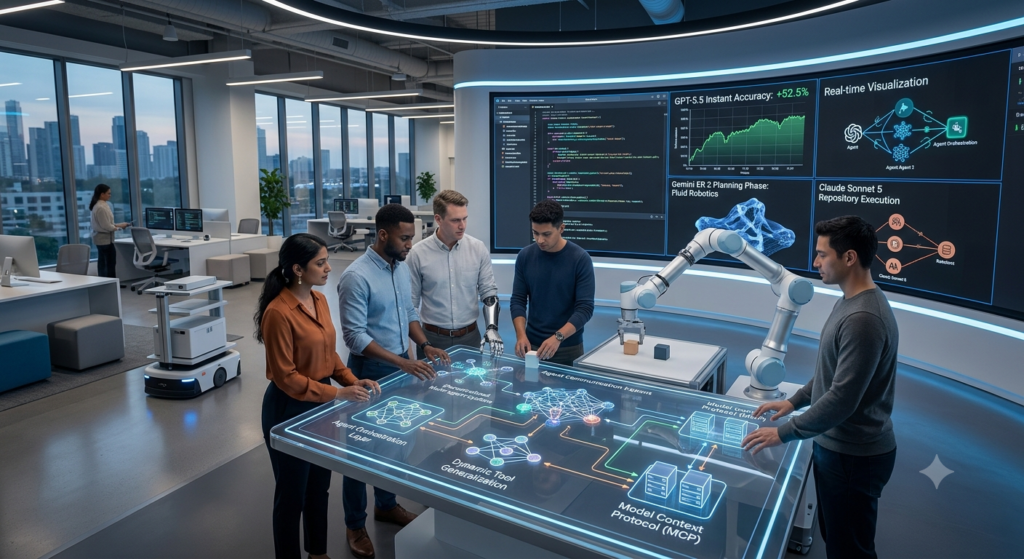
Frontier AI models in 2026 are rapidly evolving into autonomous, multi-agent systems. Recent releases highlight a major shift toward embodied robotics reasoning, seamless tool orchestration, and high-efficiency models capable of prolonged, self-directed execution across software and physical environments.
1.Google DeepMind Launches Gemini Robotics ER 2
What happened: Google DeepMind introduced Gemini Robotics ER 2, an “embodied reasoning” model that processes real-time video to orchestrate physical actions. It allows robots to plan multi-step tasks, self-correct on the fly, and seamlessly collaborate with other robots in shared spaces.
Why it matters: It replaces the slow “stop-and-think” latency in robotic AI, enabling fluid, real-world physical automation and complex tool use.
Source: Google Blog — Introducing Gemini Robotics ER 2
2.Meta Unveils Muse Spark 1.1 for Orchestrating Multi-Agent Systems
What happened: Meta launched Muse Spark 1.1, a multimodal reasoning model optimized for agentic execution, computer use, and coding. Designed to optimize end-to-end latency, it natively coordinates parallel subagents, generalizes to custom tools, and seamlessly interacts with Model Context Protocol (MCP) servers.
Why it matters: It establishes a robust architecture for personal superintelligence by efficiently distributing and managing complex user requests across multiple specialized AI agents.
Source: Meta AI — Introducing Muse Spark 1.1
3.Anthropic Releases Claude Sonnet 5 for Autonomous Software Engineering
What happened: Anthropic released Claude Sonnet 5, designating it as their most agentic Sonnet model to date. The model is explicitly engineered to handle sustained autonomous coding, terminal usage, and multi-step planning within complex enterprise codebases.
Why it matters: It brings high-end autonomous coding and debugging capabilities to a highly cost-effective, low-latency execution tier.
Source: Anthropic — Introducing Claude Sonnet 5
4.OpenAI Debuts GPT-5.5 Instant with Enhanced Accuracy and Fast Inference
What happened: OpenAI released GPT-5.5 Instant, a high-efficiency model featuring a 52.5% reduction in hallucinated claims on high-stakes tasks. The model provides tighter reasoning, improved photo analysis, dynamic context retrieval, and enhanced control over response personalization.
Why it matters: It significantly increases the reliability and safety of high-speed model inference in critical, fact-dependent domains like medicine, law, and finance.
Source: OpenAI — GPT-5.5 Instant: smarter, clearer, and more personalized
5.Meta Releases TRIBE v2 Neural Predictive Foundation Model
What happened: Meta open-sourced TRIBE v2, a foundation model acting as a digital twin for human neural activity. The model predicts how the human brain processes visual and auditory stimuli with a 70x resolution increase over previous systems.
Why it matters: It provides neuroscientists and AI researchers with computational simulations to test theories without human subjects, potentially bridging biological and artificial intelligence.
Source: Meta AI — Introducing TRIBE v2
Emerging Trends:
- Shift to Autonomous Action: Leading labs are aggressively upgrading their mid-tier models from conversational assistants into self-directed agents capable of complex tool use, multi-step planning, and executing long-horizon tasks across browsers and terminals.
- Embodied and Physical AI: The development of specialized spatial reasoning engines, like Gemini Robotics ER 2, highlights a push to integrate real-time multimodality into robotics, bridging the gap between digital AI logic and fluid physical movement.
- Multi-Agent Orchestration: Model architectures are increasingly focused on multi-agent collaboration frameworks, allowing a primary model to act as a manager that delegates subtasks to specialized parallel agents for faster, more accurate execution.