Today’s Graph AI developments focus on replacing heuristic extractions with task-optimized graph construction and deterministic retrieval. From reinforcement learning–driven knowledge graph building to pre-trained Graph Foundation Models and federated GQL engines, architectures are eliminating non-deterministic partitions and excessive token overhead to maximize speed and precision.
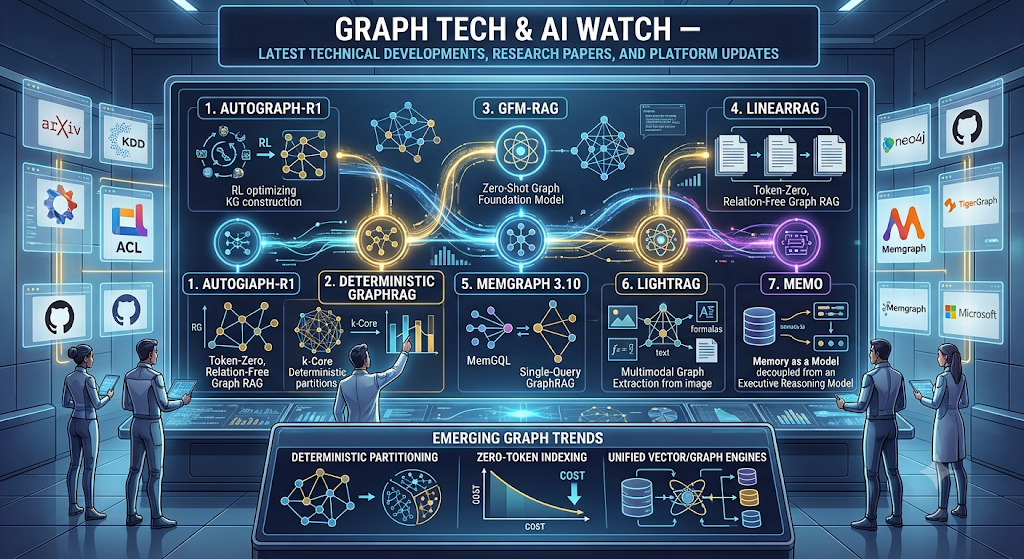
1. AutoGraph-R1: Closed-Loop RL Framework for Knowledge Graph Construction
What happened: Researchers introduced AutoGraph-R1, an end-to-end reinforcement learning framework that directly optimizes Knowledge Graph (KG) construction using downstream RAG pipeline performance as its explicit reward signal. The system frames graph extraction as a policy learning problem, employing task-aware reward functions that evaluate graphs as both knowledge carriers and retrieval indices.
Why it matters: It bridges the disconnect between static, task-agnostic LLM graph extraction rules and downstream application needs, ensuring generated graph topologies are trained specifically to maximize multi-hop question-answering accuracy.
Tech Stack/Concepts: Reinforcement Learning, Policy Optimization, Knowledge Graph Construction, Graph RAG, Task-Aware Reward Functions.
Source: ACL Anthology / ACL 2026 Status: Research Paper | Date: May 2026
2. Deterministic GraphRAG: Replacing Leiden Clustering with k-Core Decomposition
What happened: A research paper accepted at KDD 2026 demonstrates that standard Leiden community detection in GraphRAG admits exponentially many near-optimal partitions on sparse knowledge graphs, causing inherent non-reproducibility. To resolve this, the authors replace Leiden with linear-time k-core decomposition to build deterministic, density-aware graph hierarchies paired with token-budget–aware sampling heuristics.
Why it matters: Eliminates non-deterministic graph community partitioning while significantly reducing token sampling costs and graph indexing latency during global sensemaking tasks across large document collections.
Tech Stack/Concepts: k-Core Graph Decomposition, Hierarchical Community Detection, Modularity Optimization, Global Sensemaking, GraphRAG.
Source: arXiv:2603.05207 Status: Research Paper (KDD 2026) | Date: March 2026 (Revised June 2026)
3. GFM-RAG: Zero-Shot Graph Foundation Model for Structural Reasoning
What happened: GFM-RAG introduces a zero-shot Graph Foundation Model (GFM) built specifically for Retrieval-Augmented Generation, using a non-parametric DistMult GNN message-passing architecture. Pre-trained across 60 knowledge graphs comprising over 14 million triples and 700k documents, GFM-RAG reasons directly over topological graph structures without requiring dataset-specific fine-tuning.
Why it matters: Bypasses LLM extraction bottlenecks by providing a pre-trained structural GNN foundation model that transfers across unseen domain graphs out of the box, achieving an 18.9% average accuracy improvement over zero-shot baselines.
Tech Stack/Concepts: Graph Foundation Models (GFM), DistMult Message Passing, ColBERTv2 Entity Resolution, Zero-Shot Graph Retrieval.
Source: arXiv:2502.01113 Status: Research Paper | Date: February 2025 / Updated 2026
4. LinearRAG: Token-Zero, Relation-Free Graph RAG for Massive Corpora
What happened: Accepted at ICLR 2026, LinearRAG introduces a relation-free graph construction method engineered to scale GraphRAG across large corpora. Instead of using costly LLM extraction prompts to define entity-relation predicates, LinearRAG links entities via sentence- and document-level semantic co-occurrence paths.
Why it matters: Reduces graph construction token consumption and indexing runtime to near-zero while maintaining multi-hop structural retrieval quality across enterprise document stores.
Tech Stack/Concepts: Relation-Free Graph Indexing, Co-occurrence Topologies, Subgraph Traversal, ICLR 2026, Python.
Source: GitHub – DEEP-PolyU/LinearRAG Status: Open-Source Framework / Research Paper (ICLR 2026) | Date: January 2026
5. Memgraph 3.10 Introduces MemGQL Engine and Single-Query Atomic GraphRAG
What happened: Memgraph released version 3.10, introducing MemGQL—a federated ISO GQL engine capable of querying live data sources directly via Bolt drivers. The release also updates Memgraph’s single-store HNSW vector index to maintain in-memory vector-graph sync without duplicate memory allocation, enabling “Atomic GraphRAG” single-query execution.
Why it matters: Substantially cuts RAM requirements for hybrid graph-vector workloads and eliminates multi-hop query overhead by running vector filtering and graph traversal in a unified query pass.
Tech Stack/Concepts: ISO GQL Standard, MemGQL, HNSW Vector Indexing, Single-Query Atomic GraphRAG, Cypher.
Source: Memgraph Product Blog Status: GA Production Release | Date: May 2026
6. LightRAG Integrates Multimodal Engine and Decoupled Multi-Role LLM Pipelines
What happened: The open-source LightRAG framework integrated RagAnything (via MinerU/Docling) to extract knowledge graphs directly from multimodal assets including images, complex formulas, and tables. Additionally, the architecture introduced role-decoupled LLM execution across four isolated runtime tasks: Extraction, Querying, Keyword Generation, and Vision-Language Processing.
Why it matters: Enables developers to optimize cost and speed by pairing lightweight local models for entity extraction while reserving high-parameter frontier models for multimodal reasoning and synthesis.
Tech Stack/Concepts: LightRAG, Multimodal Parsing, Role-Specific LLM Architecture, OpenSearch Backend, Local/Global Graph Search.
Source: GitHub – hkuds/lightrag Status: Open-Source Framework Release | Date: May–July 2026
7. MeMo: Decoupling Executive Reasoning Models from Non-Parametric Graph Memory
What happened: Researchers released MeMo (Memory as a Model), a non-parametric long-term graph memory architecture that separates memory representation from the executive LLM used for final answer synthesis. Across NarrativeQA and multi-hop reasoning benchmarks, MeMo doubled retrieval and synthesis accuracy compared to standard GraphRAG baselines.
Why it matters: Enables organizations to swap or upgrade downstream LLM reasoning engines (e.g., upgrading to newer frontier models) without re-indexing or retraining the underlying enterprise knowledge graph.
Tech Stack/Concepts: Non-Parametric Continual Learning, Graph Memory Models, Multi-Hop Narrative Reasoning, Modular RAG Architectures.
Source: arXiv:2605.15156 Status: Research Paper | Date: May 2026
Emerging Graph Trends
Today’s developments highlight three major architectural shifts in Graph AI: the move away from non-deterministic heuristic clustering toward linear, deterministic graph partitioning algorithms like k-core decomposition; the decoupling of expensive LLM entity extraction in favor of zero-token structural indexing or pre-trained Graph Foundation Models; and the integration of federated, standard-compliant query engines (ISO GQL) directly with unified vector storage. Together, these innovations are resolving the latency, token cost, and non-reproducibility bottlenecks that previously limited enterprise Knowledge Graph deployments.