The transition from AI-assisted test scripting to fully autonomous quality engineering has dramatically accelerated. Rather than simply using generative models as autocomplete wrappers for static code, the testing ecosystem is fundamentally rearchitecting itself around multi-agent workflows, closed-loop execution layers, and dynamic validation. From native AI test agents integrated directly into major browser automation frameworks to novel metamorphic testing protocols designed to validate enterprise RAG systems themselves, today’s developments showcase an industry shifting its focus toward runtime resilience, self-healing architectures, and cost-efficient agentic task decomposition.
1. Playwright v1.56 Built-In Test Agents (Planner, Generator, Healer)
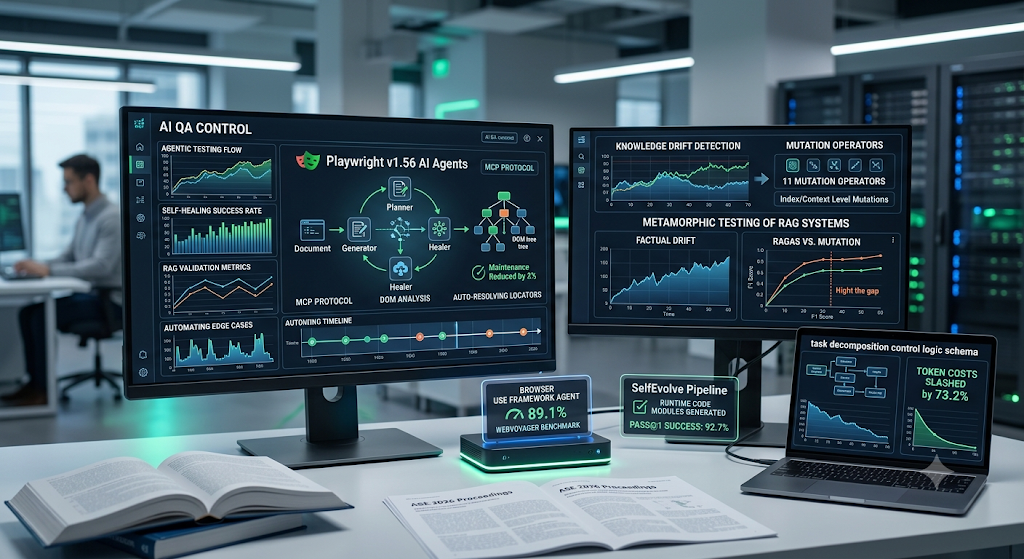
Status: Beta Feature | Release Date: April 2026 What happened: Playwright introduced native AI test agents utilizing the Model Context Protocol (MCP) to connect Large Language Models directly to live browser sessions. The architecture splits testing into three distinct roles: a Planner agent that navigates the live DOM to discover edge cases and create test plans, a Generator that translates these into executable specifications, and a Healer that automatically detects UI shifts and fixes broken locators during execution. Why it matters: It transitions end-to-end (E2E) testing from static script authoring to a resilient observer-driver pattern, drastically reducing the maintenance burden of flaky UI tests by resolving DOM and locator breakages autonomously. Tech Stack/Concepts: Playwright, Model Context Protocol (MCP), GPT/Claude integration, DOM Analysis, Flaky Test Healing. Source: TestDino Engineering Blog / Playwright Test Agents
2. Metamorphic Testing of RAG Systems with Mutations
Status: Research Paper | Publication Date: July 2026 (ASE 2026) What happened: Researchers introduced a metamorphic testing framework to evaluate the resilience of Retrieval-Augmented Generation (RAG) systems against evolving corpus data—a scenario where traditional static benchmark snapshots (like RAGAS) frequently fail. The framework systematically applies 11 mutation operators at both the retrieval index (pre-chunk) and retrieved context (post-chunk) levels to trigger and measure factual drift. Why it matters: It exposes critical blind spots in enterprise GenAI validation, achieving an F1 fault-detection score of 0.927 to 1.000 (compared to RAGAS’s 0.570) while providing actionable mitigation paths via retrieval re-configuration and LLM-based reranking. Tech Stack/Concepts: Metamorphic Testing, RAG Architecture, Mutation Testing, RAGAS, Knowledge Drift. Source: arXiv:2607.26843
3. SMART: Semantic Mutation with Adaptive Retrieval and Tuning
Status: Research Paper | Publication Date: March 2026 What happened: To overcome the limitations of generic LLM-driven mutation testing, the SMART framework integrates retrieval-augmented generation on a vectorized dataset of real-world bugs. By utilizing focused code chunking and supervised fine-tuning, SMART conditions the model to generate high-quality, semantically accurate test mutants that strictly mimic real developer errors rather than uncompilable syntax variations. Why it matters: It empowers smaller, cost-effective 7B-parameter models to match or exceed GPT-4o in mutation validity, raising real bug detection rates from ~58% to over 92% and significantly improving downstream test case prioritization. Tech Stack/Concepts: RAG, Vectorized Datasets, Supervised Fine-Tuning (SFT), SLMs (7B models), LLMut. Source: arXiv:2603.24560
4. Runtime-Structured Task Decomposition for Agentic Coding Systems
Status: Research Paper | Publication Date: May 2026 What happened: Addressing the brittleness and high token costs of monolithic prompt engineering in AI testing, researchers engineered an architecture that offloads task partitioning and execution flow to predefined, executable control logic schemas. In this framework, LLMs are restricted strictly to focused judgment tasks rather than controlling the entire testing and root-cause analysis workflow. Why it matters: This architectural constraint dramatically improves the reliability of agentic debugging, slashing retry token costs by up to 73.2% by only re-evaluating failed subtasks rather than forcing the model to restart an entire prompt chain upon failure. Tech Stack/Concepts: Agentic Software Engineering, Task Decomposition, Kubernetes Debugging, Schema Validation. Source: arXiv:2605.15425
5. Open-Source Agentic Web Automation with Browser Use
Status: Open-Source Framework / Benchmark Milestone | Release Date: Mid-2026 What happened: The open-source browser-use framework emerged as a dominant execution layer tailored specifically for AI agents, achieving an 89.1% success rate on the WebVoyager agent benchmark. Moving away from developer-centric wrappers, it provides an agent-native environment that natively processes visual state, handles anti-detection, supports stealth sessions, and automatically recovers from unexpected layout shifts. Why it matters: It bridges the gap between Vision-Language Models (VLMs) and functional UI testing by providing a resilient, skill-based execution layer capable of successfully navigating complex, authenticated dynamic front-ends without human intervention. Tech Stack/Concepts: Vision-Language Models (VLMs), WebVoyager Benchmark, Agentic UI Testing, Headless Browser Recovery. Source: Firecrawl Engineering Blog
6. SelfEvolve: Runtime Self-Extension via Agentic Architecture
Status: Research Paper | Publication Date: February 2026 What happened: Pushing past traditional self-healing automation, researchers unveiled SelfEvolve, an orchestrated agentic pipeline that allows software systems to autonomously generate, test, and integrate entirely new code modules at runtime based on incoming edge cases. Why it matters: Demonstrating an impressive 92.7% Pass@1 success rate on self-extension tasks without requiring developer intervention or system restarts, it radically outperforms current baseline coding agents (AutoGen, MetaGPT) and blurs the boundary between continuous testing and autonomous continuous development. Tech Stack/Concepts: AutoGen, MetaGPT, AgentCoder, Self-Adaptive Systems, Runtime Code Generation. Source: arXiv:2604.16314
Emerging QA AI Trends
1. The Shift to Agent-Native Execution Layers: Traditional automation libraries (like Selenium and vanilla Puppeteer) are being superseded by agent-native execution environments—such as browser-use and Playwright’s new MCP agents—that autonomously observe UI context, parse DOM elements, and self-heal locator strategies in real time.
2. Rigorous Evaluation of AI Itself (GenAI QA): As Generative AI moves into enterprise production, the QA discipline is evolving to become the primary accountability layer. Teams are shifting away from static benchmarks and embracing metamorphic testing pipelines to continuously monitor factual drift, retrieval degradation, and probabilistic failures in RAG systems as data corpora naturally evolve.
3. Decoupled Agentic Workflows for Cost Efficiency: To combat the exorbitant token costs and retry brittleness of monolithic LLM agents, engineering teams are adopting runtime-structured task decomposition. By enforcing deterministic control logic and relegating the AI exclusively to isolated judgment calls, platforms are dramatically reducing the overhead of automated root-cause analysis and test generation.