AI Technology Watch — September 17, 2026
Storyline Recent AI breakthroughs reveal a fundamental shift toward agentic autonomy: multi-agent networks are abandoning text for direct latent vector communication, formalizing 13-million-line mathematical proofs, and replacing static enterprise software with runtime-generated execution loops.
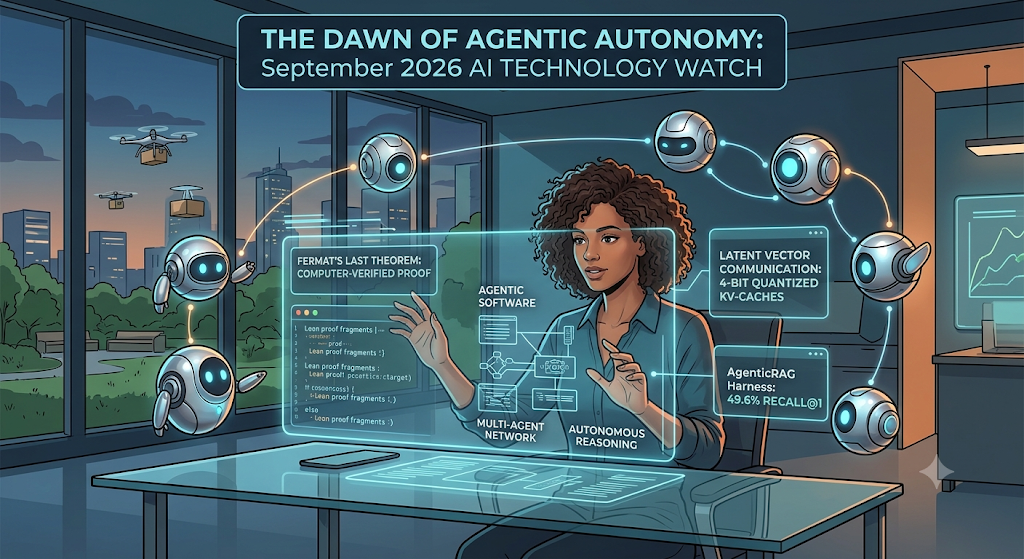
1. Anthropic Autoformalizes Fermat’s Last Theorem via Autonomous Reasoning
Publication Date: September 4, 2026 What happened: Anthropic researchers deployed Claude to autonomously write 13 million lines of Lean code over 11 days, proving 29,500 intermediate theorems. The run produced the world’s first complete, computer-verified formalization of Fermat’s Last Theorem without unverified mathematical assumptions. Why it matters: This milestone proves that reasoning models can reliably navigate deep mathematical structures and autoformalize long-horizon scientific proofs without hallucinating logical steps. Source: Anthropic Research — Formalizing Fermat’s Last Theorem
2. Latent Vector Protocols Replace Natural Language in Multi-Agent Networks
Publication Date: July 15, 2026 What happened: Researchers formalized a latent communication framework that allows LLM agents to stream hidden state trajectories and 4-bit quantized KV-caches directly to each other. Instead of serializing intermediate thoughts into natural language tokens, recipient agents prepend or inject these continuous vector activations directly into their own transformer context. Why it matters: Eliminating text token generation reduces multi-agent communication latency and token inflation while preserving rich state uncertainty and intermediate reasoning density. Source: arXiv — cs.AI
3. Google DeepMind Advances AlphaEvolve to GA for Automated Code Optimization
Publication Date: July 9, 2026 What happened: Google DeepMind transitioned its AlphaEvolve framework to General Availability on the Gemini Enterprise Agent Platform. The system pairs a fast candidate generation model with a heavy reasoning evaluator to iteratively generate, test, and mutate code and neural architectures against custom execution benchmarks. Why it matters: It shifts enterprise software engineering from static AI code generation to autonomous, evolutionary self-optimization of live production algorithms. Source: Google DeepMind — Technology Blog
4. AgenticRAG Harness Outperforms Static Vector Retrieval via Dynamic Navigation
Publication Date: May 7, 2026 What happened: Computer scientists introduced AgenticRAG, an open-source harness that equips reasoning models with autonomous search, document inspection, and multi-query navigation tools over enterprise knowledge bases. Benchmarks showed a 49.6% recall@1 on the BRIGHT dataset—a 5.9x efficiency and accuracy improvement over traditional top-k embedding vector retrieval. Why it matters: It replaces rigid embedding search with dynamic, multi-turn evidence gathering that mimics how human domain experts analyze complex document repositories. Source: arXiv — cs.AI
5. Research Paper Formalizes ‘Agentic Software’ as Dynamic Execution Logic
Publication Date: June 4, 2026 What happened: Software engineering researchers formalized the transition from traditional static codebases to “Agentic Software,” where LLMs act as the primary runtime engine that dynamically generates, executes, and discards transient code blocks on demand. The framework defines control models for intent specification, state monitoring, and autonomous execution loops. Why it matters: It redefines the role of software engineers from writing static source code to architecting intent constraints, safety boundaries, and agentic orchestration pipelines. Source: arXiv — cs.SE
6. OpenAI Releases Open-Weight gpt-oss Reasoning Models
Publication Date: May 13, 2026 What happened: OpenAI launched gpt-oss-20b and gpt-oss-120b, an Apache 2.0 open-weight reasoning model family with a 128K context window for self-hosted infrastructure. The 20B parameter model operates within 16 GB of memory, enabling local hardware execution of step-by-step chain-of-thought reasoning without sending data to cloud APIs. Why it matters: It provides enterprise architecture teams with a permissively licensed, open-weight reasoning base model that runs on local workstations for strict data residency compliance. Source: Hugging Face Blog
7. Qwen3 Mixture-of-Experts Architecture Scales Multilingual Tool Execution
Publication Date: May 13, 2026 What happened: Alibaba released the open-weight Qwen3 model family, led by Qwen3-235B-A22B, a Sparse Mixture-of-Experts model that routes execution through 22B active parameters per token. The model provides native tool orchestration and function calling across 100+ languages under an Apache 2.0 license. Why it matters: Sparse parameter routing dramatically lowers the active compute cost of hosting frontier-grade multilingual agent orchestration on enterprise private clouds. Source: Hugging Face Blog
Emerging Trends
- Direct Latent Interoperability: Multi-agent architectures are shifting from natural language token exchanges to direct latent vector sharing, state delta trajectory passing, and persistent KV-cache injection to cut latency and preserve internal reasoning density.
- Shift from Static Code to Intent Runtimes: Foundation models are turning static software engineering into runtime logic generation, where agents write, test, and discard temporary code on the fly to fulfill high-level user intentions.
- Local High-Capacity Reasoning: The arrival of Apache 2.0 open-weight reasoning models and sparse Mixture-of-Experts architectures enables enterprise teams to run local, privacy-compliant agentic loops on standard edge hardware.