AI Quality Engineering Watch — September 18, 2026
As software organizations increasingly deploy autonomous coding agents to author pull requests, Quality Engineering is undergoing a structural paradigm shift. Static script creation and manual assertion authoring are being superseded by closed-loop agentic quality harnesses, accessibility-tree-first test engines, and solver-guided verification loops. Concurrently, empirical benchmarks are exposing critical coverage gaps in agent-generated code, forcing engineering teams to implement automated agent-to-agent review gates and multi-stage reproduction frameworks.
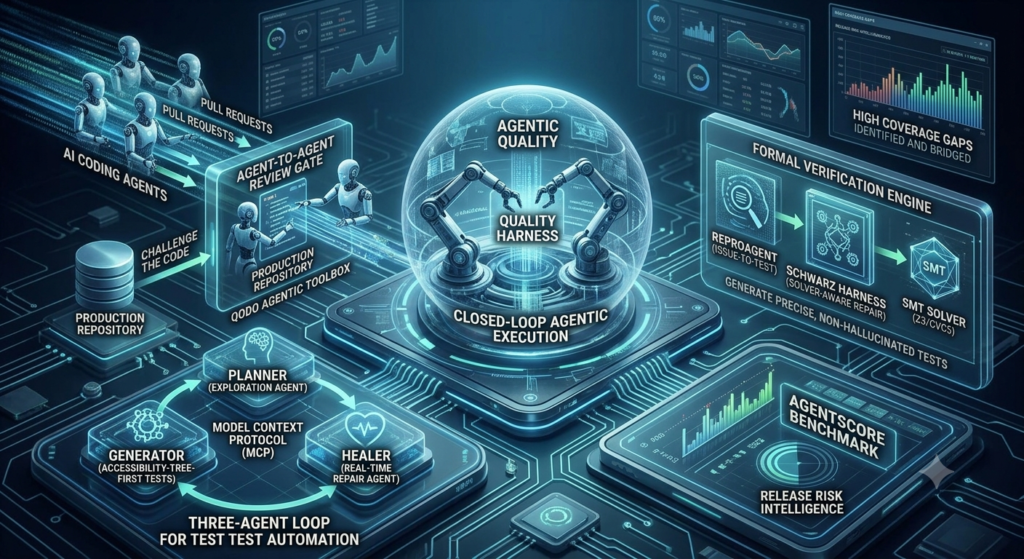
1. Qodo Launches Agentic Toolbox for Agent-to-Agent Code Review and Governance
- Status: GA Enterprise Release | Date: September 9, 2026
- What happened: Qodo launched its Agentic Toolbox, a unified suite of quality and governance tools designed to perform adversarial agent-to-agent code reviews against AI coding models like Claude Code, Codex, and Kiro. The platform draws context across repository ASTs, pull request histories, and engineering policies to challenge proposed code changes, evaluate untested logic paths, and auto-generate unit tests before code merges.
- Why it matters: Establishes an independent, policy-driven governance layer that prevents unverified or undertested code generated by developer AI agents from entering production branches.
- Tech Stack/Concepts: Multi-Agent Review Architecture, AST Parsing, Repository Context Engine, Agent-to-Agent Governance, LangGraph Workflows.
- Source: [GlobeNewswire / Qodo](https://www.globenewswire.com/news-release/2026/09/09/3358726/0/en/qodo-launches-the-first-agent-to-agent-code-review-and-governance.html)
2. Tricentis Unveils Autonomous ‘Aida’ Agent and ‘AgentScore’ Evaluation Framework
- Status: Enterprise Beta Feature | Date: August 20, 2026
- What happened: Tricentis introduced ‘Aida’, an autonomous testing agent that explores web and Windows desktop applications to uncover application defects and coverage gaps without pre-scripted test suites. In parallel, Tricentis introduced ‘AgentScore’, a framework that transitions quality engineering from deterministic assertions to probabilistic evaluation of AI agent behaviors, combined with topology-based Release Risk Intelligence.
- Why it matters: Replaces fragile pre-scripted UI test journeys with risk-weighted autonomous exploration while providing enterprise teams with standardized metrics to evaluate AI testing agent reliability.
- Tech Stack/Concepts: Autonomous Exploration Agents, AgentScore Benchmark, Application Topology Mapping, Release Risk Intelligence.
- Source: Tricentis Newsroom
3. Playwright Integrates Native MCP and Three-Agent Testing Loop (planner, generator, healer)
- Status: Open-Source Framework Feature | Date: September 1, 2026
- What happened: Playwright’s ecosystem update integrated the Model Context Protocol (MCP) and introduced three specialized AI testing agents—
planner,generator, andhealer—operating in a closed loop. Theplanneragent explores web applications to build structured Markdown test plans,generatoremits TypeScript tests using accessibility-tree locators (getByRole), andhealerdiagnoses and repairs broken selectors in real time using DOM accessibility snapshots. - Why it matters: Eliminates hand-coded test boilerplate and selector fragility by grounding test generation and self-healing in semantic accessibility trees rather than brittle CSS/XPath locators.
- Tech Stack/Concepts: Playwright 1.56+, Model Context Protocol (MCP), Accessibility-Tree Locators, Self-Healing Execution Loops.
- Source: [TestDino / Playwright AI Ecosystem](https://testdino.com/blog/playwright-ai-ecosystem)
4. Large-Scale Empirical Study Uncovers High Coverage Gaps in Agent-Generated PRs
- Status: Research Paper | Date: July 20, 2026
- What happened: An empirical study analyzing 4,882 pull requests created by AI coding agents across Java and Python revealed that agents include unit test modifications in only 49.6% of code-changing PRs. Regression suites covered only 61.5% of agent-authored code in Java and 27.0% in Python, with critical error-handling constructs (such as try-catch blocks) remaining unverified in up to 86% of cases.
- Why it matters: Quantifies the hidden technical debt introduced by autonomous coding tools, highlighting the mandatory need for automated coverage feedback loops in modern CI/CD pipelines.
- Tech Stack/Concepts: Static Code Analysis, AST Exception Path Analysis, Line Coverage Metrics, Agentic Software Development.
- Source: [arXiv:2607.18057](https://arxiv.org/abs/2607.18057)
5. ReProAgent Automates Issue-to-Test Reproduction via Multi-Stage Agentic Framework
- Status: Research Paper | Date: July 10, 2026
- What happened: Researchers released ReProAgent, a tool-augmented multi-stage agent framework that converts raw GitHub issue reports into executable reproduction unit tests. By splitting the task into bug localization, root cause analysis, test planning, and test generation stages while querying repository knowledge graphs, ReProAgent achieved a 70.30% reproduction success rate on SWT-bench-verified.
- Why it matters: Automates one of the most tedious tasks in software engineering—reproducing reported bugs with executable unit tests—reducing developer triage overhead.
- Tech Stack/Concepts: ReProAgent, Repository Knowledge Graphs, Multi-Stage LLM Agents, Sandboxed Execution Environments.
- Source: arXiv:2607.09123
6. Schwarz Harness Introduces Solver-Aware Repair for Agentic Program Verification
- Status: Research Paper | Date: August 31, 2026
- What happened: Researchers introduced Schwarz, an agentic program verification harness that converts SMT solver failures into obligation-local repair tasks. By providing program-point snapshots and deploying theory-aware solver policies, Schwarz guides language models to refine missing lemmas and proof contexts, achieving a 95.2% verification rate across 1,475 C and Rust/Verus benchmarks.
- Why it matters: Overcomes the “opaque error” bottleneck in automated formal verification, enabling AI agents to repair failed proof obligations without getting stuck in solver timeouts.
- Tech Stack/Concepts: SMT Solvers (Z3/CVC5), Rust/Verus, Program-Point Snapshots, Theory-Aware Local Proof Repair.
- Source: [arXiv:2608.30803](https://arxiv.org/abs/2608.30803)
7. PDFuzzer Combines Constraint Solvers and LLMs for Multi-API Sequence Fuzzing
- Status: Research Paper | Date: August 6, 2026
- What happened: Researchers created PDFuzzer, a fuzzing framework for PDF document engines that uses LLMs to extract API dependencies from documentation and execution traces into context-free grammars. PDFuzzer feeds these grammars into constraint solvers to synthesize complex multi-API call sequences, outperforming state-of-the-art fuzzers by 48% and identifying 31 zero-day security vulnerabilities.
- Why it matters: Demonstrates how combining LLMs with formal constraint solving can dramatically improve non-functional security testing and vulnerability discovery in complex libraries.
- Tech Stack/Concepts: Large Language Models, Constraint Solvers, Context-Free Grammars, API Dependency Graphing, Fuzz Testing.
- Source: arXiv:2608.06641
8. SpecPath Framework Identifies Specification-Path Sensitivity in Coding Agents
- Status: Research Paper | Date: August 10, 2026
- What happened: Researchers developed SpecPath, a diagnostic benchmark that evaluates whether coding agents produce identical code when requirements evolve through different equivalent revision paths. Testing across 14 agent configurations revealed that 35% of tasks that succeeded under direct specifications failed when presented with equivalent multi-revision paths, exposing a core vulnerability in agentic contract resolution.
- Why it matters: Reveals that test and code generation agents are highly sensitive to how requirement histories are structured, calling for multi-path specification testing in agent evaluation.
- Tech Stack/Concepts: Contract Resolution Analysis, Evolving Requirement Benchmarking, Specification Path Sensitivity, Paired Behavioral Verification.
- Source: [arXiv:2608.09799](https://arxiv.org/abs/2608.09799)
Emerging QA AI Trends
Across recent technical advances, three distinct shifts define the current direction of AI Quality Engineering. First, test execution is shifting from static, hand-written locator scripts to closed-loop agentic architectures that leverage accessibility-tree representations and Model Context Protocols (MCP) for autonomous exploration and self-healing. Second, enterprise QA is establishing independent “agent-to-agent” governance harnesses and reliability metrics (such as AgentScore) to validate undertested pull requests generated by autonomous developer tools. Finally, state-of-the-art test generation is increasingly coupling language models with formal reasoning structures—such as SMT constraint solvers, repository knowledge graphs, and multi-stage execution sandboxes—to generate precise, non-hallucinated test assertions and reproduction scripts.