Graph Tech & AI Watch — September 26, 2026
Here is your Graph Tech & AI Watch for late September 2026. This edition covers asynchronous graph retrieval using diffusion models, hypergraph construction with zero token consumption, atomic query pipelines in Memgraph 3.10, and critical memory optimizations for vector handling inside Neo4j.
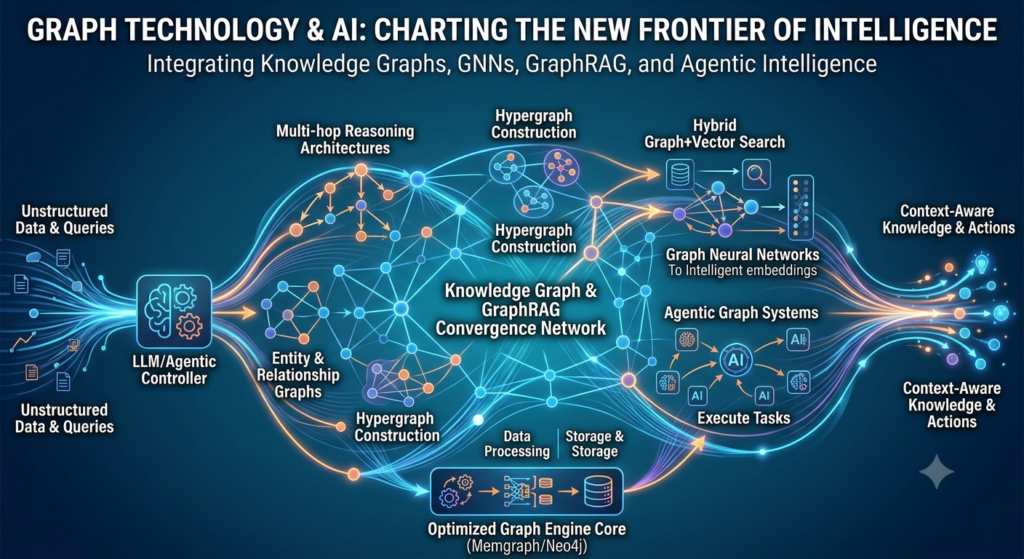
1. Ladder: Graph-Guided Diffusion Language Models for Efficient Multi-hop Reasoning
What happened: Researchers introduced an asynchronous self-clocking policy that dynamically triggers graph retrieval only when the set of graph-linkable entities expands during text generation. By utilizing an incomplete-query graph propagation module and Diffusion Language Models (DLMs), it aggregates multi-hop evidence continuously rather than relying on synchronous retrieval bottlenecks.
Why it matters: This architecture bypasses the computational lag of traditional multi-hop aggregation, accelerating overall decoding convergence and significantly speeding up complex reasoning tasks over large graphs.
Tech Stack/Concepts: Diffusion Language Models (DLMs), Asynchronous Retrieval, Graph Foundation Models.
Source: arXiv:2609.24346
2. EHRAG: Bridging Semantic Gaps via Hybrid Hypergraph Construction
What happened: The EHRAG framework introduces a lightweight GraphRAG approach that builds a hypergraph capturing both structural co-occurrences and latent semantic relationships by clustering entity text embeddings. It relies on a structure-semantic hybrid diffusion process with Personalized PageRank (PPR) refinement to locate relevant documents.
Why it matters: EHRAG overcomes the limitation of traditional entity extraction that misses disjoint but semantically connected entities, all while maintaining linear indexing complexity and zero token consumption during construction.
Tech Stack/Concepts: Hypergraphs, Personalized PageRank (PPR), Hybrid Structural-Semantic Retrieval.
Source: arXiv:2604.17458
3. Memgraph 3.10 & Atomic GraphRAG Single-Query Pipelines
What happened: Memgraph released version 3.10 alongside its Atomic GraphRAG architecture, which executes exact local graph searches via a single-query execution layer. The release also introduces memory efficiency updates to its Single-Store Vector Index, allowing vector and graph data to stay synchronized without data duplication.
Why it matters: By condensing analytical retrieval into a single query pipeline, developers can drastically reduce context engineering overhead and stabilize highly concurrent, multi-tenant GraphRAG applications in production.
Tech Stack/Concepts: Memgraph 3.10, MemGQL, Single-Store Vector Index, Atomic GraphRAG.
Source: Memgraph Blog
4. MixRAGRec: Mixture-of-Experts Multi-Agent KG Retrieval
What happened: A novel cooperative multi-agent framework was published that utilizes a Mixture-of-Experts (MoE) Retrieval Agent to route user queries to different Knowledge Graph extraction agents based on required granularity. The architecture integrates a Knowledge Preference Alignment Agent to translate graph-structured knowledge into natural language without noise injection.
Why it matters: It directly solves the over-retrieval and under-retrieval problems in standard GraphRAG systems by dynamically adjusting the graph traversal depth, specifically optimizing LLM-based recommender systems.
Tech Stack/Concepts: Mixture-of-Experts (MoE), Multi-Agent Policy Optimization, Knowledge Graph Alignment.
Source: arXiv:2605.28175
5. CS-RAG: Mitigating Retrieval Drift from Imperfect Knowledge Graphs
What happened: Addressing the reality that automated LLM-built knowledge graphs often contain spurious noise, researchers developed CS-RAG, a framework that plans queries as an ordered sequence of executable atomic constraints. It applies a strict sufficiency check before binding variables for subsequent propagation, reverting to textual recovery if structural support is incomplete.
Why it matters: Instead of relying on expensive graph repair operations, this architectural shift gracefully handles imperfect graphs during the retrieval phase, drastically reducing hallucination in multi-hop QA.
Tech Stack/Concepts: Atomic Constraints, Multi-hop QA, Structural Sufficiency Checks.
Source: arXiv:2603.14828
6. Neo4j 2026.x: Vector-3.0 Indexes & Parquet Import Integration
What happened: The recent Neo4j 2026.x system updates introduced native support for importing vector values directly from native Parquet list types during database bulk loads. Additionally, a fix to the “vector-3.0” index correctly utilizes quantized vector data during read operations.
Why it matters: These engine-level enhancements significantly reduce memory bloat when querying large-scale enterprise vector data alongside property graphs, making native graph-vector hybrid workloads highly efficient.
Tech Stack/Concepts: Cypher, Parquet, Vector-3.0 Indexes, High-Parallel I/O.
Source: Neo4j 2026 GitHub Changelog
Emerging Graph Trends
The latest developments highlight a concerted shift toward robust, fault-tolerant graph retrieval that operates effectively even with imperfectly constructed schemas. We are seeing a convergence of multi-agent orchestration and dynamic retrieval routing—using techniques like diffusion models and mixture-of-experts—to eliminate the rigid synchronous traversals of early GraphRAG. Concurrently, native graph engines like Memgraph and Neo4j are embedding vector handling directly into core memory and storage architectures, cementing the hybrid property-vector graph as the standard for enterprise AI.