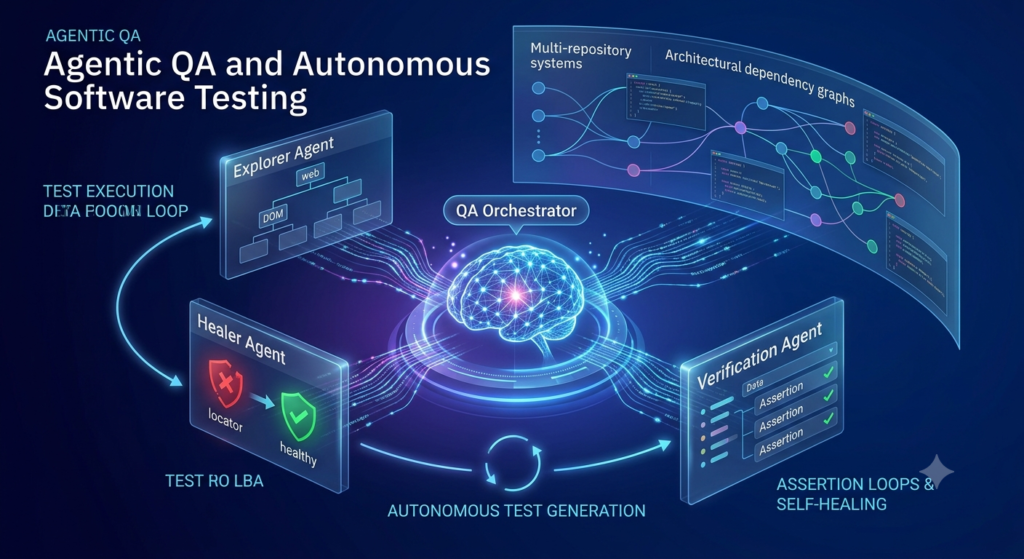
Agentic QA: Navigating the New Frontier of Autonomous Software Testing
AI Quality Engineering Watch
Context: Autonomous testing is shifting from isolated script generation to system-wide agentic loops. As AI coding agents rapidly increase code velocity, quality engineering teams face a new verification bottleneck. Modern frameworks are responding by integrating Model Context Protocol (MCP) tool interfaces, multi-repo architectural graph analysis, and multi-agent execution loops to enforce software integrity in real time.
What happened: Qodo introduced the “Software Map,” an AI agentic governance tool that continuously analyzes multi-repository codebases to chart system topologies, cross-service contracts, and dependency blast radiuses. When pull requests are created, autonomous review agents query this dynamic map to verify downstream breaking changes across up to 180 connected repositories.
Why it matters: Prevents architectural drift and cross-repository regressions caused by AI-generated code by serving continuous, live dependency context directly into autonomous review loops.
2. Framework and Benchmark for Code-Driven Agentic Testing in Web Development
Status: Research Paper (EMNLP 2026)
Publication Date: August 31, 2026
What happened: Researchers published a framework and benchmark (arXiv:2609.00081) evaluating code-driven agentic testing for complex web applications. The benchmark combines DOM tree inspection with Vision-Language Models (VLMs) to navigate multi-step user workflows and verify runtime state assertions. Evaluation across mainstream VLMs demonstrated that visual-only processing struggles with modern enterprise frontends, underscoring the necessity of DOM-assisted, code-driven agent tool invocation.
Why it matters: Establishes rigorous empirical baselines for autonomous E2E web testing, showing that hybrid DOM-and-visual agents outperform visual-only models in assertions and interaction accuracy.
Tech Stack / Concepts: Vision-Language Models (VLMs), DOM Tree Parsing, Code-Driven Agentic Workflows, Web Benchmarking.
3. Playwright Native Agentic Suite Leverages Model Context Protocol (MCP)
Status: GA Production Release (v1.60.0)
Release Date: September 2026
What happened: Playwright expanded its agentic test generation capabilities—featuring dedicated Planner, Generator, and Healer agents—alongside the playwright-cli execution interface. Built on the Model Context Protocol (MCP), these agents execute structured browser commands directly against the DOM rather than relying on pixel-coordinate guessing.
Why it matters: Reduces initial test script drafting from hours to minutes while delivering an 89% automated healing accuracy rate for UI locator shifts.
Tech Stack / Concepts: Model Context Protocol (MCP), Playwright Test Agents, playwright-cli, Smart Selector Engine.
4. Semantic AI Visual Review Agents & ARIA Tree Baselines Replace Pixel Diffing
Status: GA Production Release
Release Date: September 29, 2026
What happened: Visual testing platforms (Applitools, Percy, and Playwright 1.62+) shifted from pixel-matching to accessibility-tree verification (toMatchAriaSnapshot) paired with semantic AI diff agents. The AI review agents parse DOM accessibility structure alongside lossless WebP image captures to categorize layout shifts, color changes, and text edits into natural-language change summaries.
Why it matters: Eliminates false-positive visual regression flags caused by minor rendering differences, cutting visual test review times by up to 3x in continuous integration pipelines.
Tech Stack / Concepts: Accessibility Tree Snapshots (ARIA), Lossless WebP Baselines, Applitools Visual AI, Percy AI Review Agent.
5. Empirical Trace Study Quantifies Resource Patterns of AI Testing Agents
Status: Research Paper (arXiv:2608.00101)
Publication Date: July 30, 2026
What happened: A large-scale study analyzed production execution traces from developer workflows (e.g., GitHub Copilot, Claude Code) to characterize agentic test execution dynamics. The study revealed severe token asymmetry—averaging 68K prompt tokens to 247 output tokens per step—and tight sequential execution dependencies across GPU-backed inference and CPU-backed sandbox test runs.
Why it matters: Provides concrete infrastructural metrics for QA platform leaders designing enterprise CI/CD clusters capable of hosting concurrent autonomous agent loops.
6. Qodo Launches CLI-Powered “Agentic Toolbox” for Autonomous Code Governance
Status: Enterprise GA Release
Release Date: September 9, 2026
What happened: Qodo released the “Agentic Toolbox,” a CLI-based quality framework engineered to run inline alongside AI coding agents in developer workstations and CI runners. The toolbox executes agent-to-agent reviews, mines organizational quality rules, and forces local verification before code or generated unit tests can be committed.
Why it matters: Creates a strict governance boundary that catches agentic hallucinations, incomplete test coverage, and security violations at creation time.
Tool-Driven Protocol Standardization: Testing frameworks are standardizing on protocols like MCP (Model Context Protocol) to let autonomous agents execute structured, programmatic actions rather than relying on flaky visual/coordinate parsing.
Context-Aware Micro-Architectural Mapping: Quality tools are expanding beyond single-file context to continuously re-map entire service dependency graphs, enabling AI agents to assess cross-repository blast radiuses automatically.
Shift from Code Generation to Verification Infrastructure: As generative coding speeds up, engineering bottleneck focus has pivoted to agent-to-agent review, semantic diffing, and automated self-healing execution loops to handle the high volume of machine-generated code.