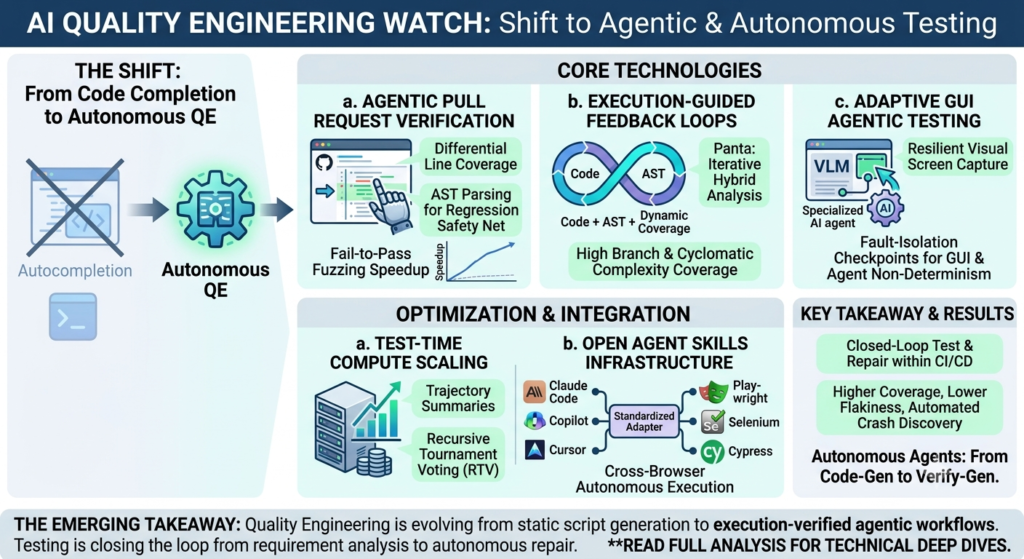
Autonomous quality engineering is evolving from static script autocompletion to adaptive execution-guided testing, agentic pull-request verification, and test-time compute scaling. Recent advances integrate static control flow analysis, visual runtime monitoring, and open skill protocols directly into CI/CD workflows.
Panta: Iterative Hybrid Program Analysis for High-Branch LLM Test Synthesis
What happened: Researchers presented Panta, an iterative feedback-driven test generation technique combining static control flow analysis with dynamic execution coverage. By continuously evaluating uncovered execution paths and cyclomatic complexity, Panta systematically guides LLMs to refine unit tests for hard-to-reach conditional branches in complex class methods.
Why it matters: Outperforms traditional LLM test generators on open-source repositories with high cyclomatic complexity, delivering 26% higher line coverage and 23% higher branch coverage.
Tech Stack/Concepts: Static Control Flow Analysis, Dynamic Code Coverage, Iterative Feedback Loop, Cyclomatic Complexity, LLM Unit Test Synthesis.
Source: arXiv:2503.13580 | Status: Peer-Reviewed Research Paper (ICSE 2026) | Date: March 17, 2025 (v2 revised August 28, 2025)
Test Coverage Safety Gaps Uncovered in Autonomous Agent Pull Requests
What happened: An empirical study analyzing 4,882 agent-generated pull requests across Java and Python codebases revealed that autonomous coding agents include unit test updates in only 49.6% of code-modifying PRs. Furthermore, existing test suites covered only 61.5% of Java line changes and 27.0% of Python line changes, leaving critical error-handling constructs (try/catch blocks) under-tested up to 86% of the time.
Why it matters: Exposes significant reliability risks in autonomous development pipelines and underscores the need for mandatory test-coverage feedback loops prior to merging agentic code changes.
Tech Stack/Concepts: Agentic PR Analysis, Differential Line Coverage, AIDev Dataset, AST Parsing, Regression Safety Net.
Source: arXiv:2607.18057 | Status: Peer-Reviewed Research Paper (IEEE ICSME 2026) | Date: July 20, 2026
SpecOps: Adaptive Multi-Agent Framework for Real-World GUI and Autonomous Agent Testing
What happened: Computer scientists engineered SpecOps, an adaptive multi-agent testing architecture designed to evaluate non-deterministic autonomous software agents through graphical user interfaces. Unlike brittle Playwright or Selenium scripts that break during dynamic response variations, SpecOps deploys specialized agents equipped with real-time visual screen capture monitoring, dynamic environment probing, and runtime fault-isolation checkpoints.
Why it matters: Replaces fragile deterministic web automation scripts with resilient visual agents capable of handling non-deterministic user interface flows and complex multi-step agent interactions.
Tech Stack/Concepts: Specialist Multi-Agent Systems, Visual Screen Capture (VLM), Adaptive Runtime Monitoring, GUI Automation, Playwright/Selenium Interoperability.
Source: arXiv:2603.10268 | Status: Open-Source Framework / Research Paper | Date: March 13, 2026
Class-First Scope Targeting Reduces LLM Test Generation Overhead
What happened: An empirical study evaluating guided test generation tools (HITS, SymPrompt, TestSpark, CoverUp) against modern frontier models demonstrated that raw LLMs can outperform complex prompt-engineering orchestrators in line coverage (+17.7%) and branch coverage (+19.8%). By first generating tests at the program class level and subsequently targeting remaining uncovered methods, the strategy reduced total LLM query costs by 20%.
Why it matters: Simplifies test synthesis pipelines by demonstrating that structured scope targeting (class-level first, then uncovered methods) is more effective and cost-efficient than complex runtime prompt orchestrators.
Tech Stack/Concepts: Class-Level Granularity, Mutation Score Analysis, Test Compilation Feedback, Frontier LLMs, TestSpark.
Source: arXiv:2601.09695 | Status: Research Paper | Date: January 14, 2026 (v2 revised July 29, 2026)
Scaling Test-Time Compute for Long-Horizon Agentic Coding and Test Repair
What happened: Researchers introduced Recursive Tournament Voting (RTV) and Parallel-Distill-Refine (PDR), a test-time compute scaling framework for long-horizon agentic testing and code repair. The framework compresses complex execution rollouts into compact trajectory summaries containing failure modes and hypothesis traces, allowing testing agents to select and reuse past execution experiences without exceeding context limits.
Why it matters: Significantly accelerates automated bug resolution and test repair performance, boosting Claude 4.5 Opus accuracy on SWE-Bench Verified from 70.9% to 77.6%.
Tech Stack/Concepts: Test-Time Scaling, Trajectory Summaries, Recursive Tournament Voting (RTV), Parallel-Distill-Refine (PDR), Agentic Test Repair.
Source: arXiv:2604.16529 | Status: Open-Source Framework / Research Paper | Date: April 16, 2026
Open Agent Skills Infrastructure Enables Cross-Browser Agentic Test Execution
What happened: An open-source release introduced standardized agent-skills wrappers across Playwright, Selenium, and Cypress for 15+ programming languages. The framework allows AI coding assistants (such as Claude Code, Copilot, and Cursor) to execute cross-browser test suites, manage cloud execution tunnels, and perform visual UI validations autonomously.
Why it matters: Standardizes the interface between developer coding assistants and enterprise test clouds, allowing AI agents to author and execute cross-browser automation without human infrastructure configuration.
Tech Stack/Concepts: Agent Skills, Playwright, Selenium, Cypress, Model Context Protocol (MCP), Cloud Test Execution Grid.
Source: LambdaTest GitHub Agent Skills | Status: Open-Source Framework / Production Release | Date: May 13, 2026
Emerging QA AI Trends:
Quality Engineering is rapidly transitioning from static unit-test generation to execution-guided feedback loops that pair AST analysis with dynamic runtime coverage metrics. Simultaneously, non-deterministic GUI testing is shifting away from fixed selector scripts toward adaptive visual multi-agent architectures capable of real-time screen capture analysis and self-healing execution. Finally, test-time compute scaling and compressed rollout summaries are becoming essential for enabling autonomous coding agents to reliably verify and repair their own pull requests before merge.