Here is the latest breakdown of core technical breakthroughs, architectural shifts, and model advancements shaping the AI landscape today.
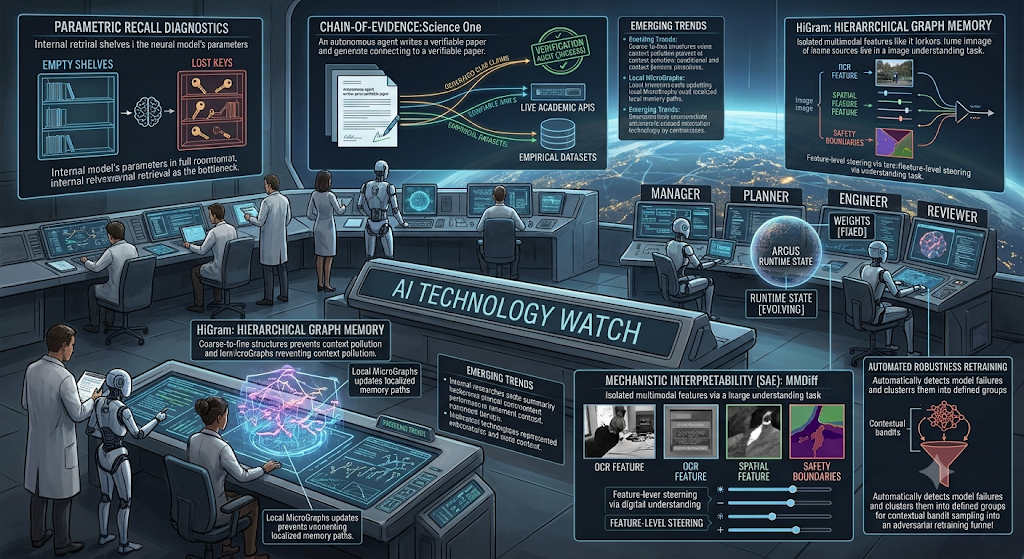
- Internal Recall Replaces Parameter Scaling as Core Factuality Bottleneck
What happened: Researchers at Google Research introduced a diagnostic framework that evaluates parametric factuality in frontier language models by distinguishing between missing knowledge (“empty shelves”) and retrieval failure (“lost keys”). Empirical evaluation across Gemini and GPT series models demonstrated that while 95–98% of factual knowledge is successfully encoded in parameters during pre-training, models fail to directly recall 26–34% of those facts during generation. This confirms that factual hallucinations in frontier models stem predominantly from internal retrieval bottlenecks rather than an absence of stored knowledge.
Why it matters: This shifts the trajectory of AI reliability engineering from brute-force data expansion toward post-training techniques that optimize internal parameter retrieval.
Source: Google Research Blog (August 12, 2026)
- Native Chain-of-Evidence Framework Eliminates Autonomous Agent Hallucinations
What happened: Google Research developed Science One, an experimental research prototype that enforces a “Chain-of-Evidence” (CoE) architectural constraint during generation. Rather than generating post-hoc citations, the framework binds every generated claim to a verifiable execution output, empirical dataset, or literature reference retrieved via academic APIs. An automated verification protocol (CoE Audit) evaluates the resulting papers by cross-checking code execution and bibliography entries against live databases to prevent phantom references.
Why it matters: Requiring real-time evidence binding at generation time provides a proven architectural blueprint for fully verifiable autonomous research agents.
Source: Google Research Blog (July 30, 2026)
- Hierarchical Graph Memory Enables Token-Efficient Long-Horizon Agent Recall
What happened: Researchers introduced HiGram, an evolving hierarchical graph memory framework designed to prevent context pollution in continuous agent workflows. The architecture organizes historical interaction memories into a coarse-to-fine hierarchy and employs conditioned MicroGraphs to localize evidence paths before updating dependency structures. In long-term conversational and conflict-aware benchmarks, HiGram improved retrieval accuracy while significantly reducing token consumption.
Why it matters: Localizing memory updates through hierarchical path rewriting allows autonomous agents to maintain long-term state across dynamic information updates without inflating inference costs.
Source: arXiv (August 5, 2026)
- Fixed-Weight Persistent Runtime Argus Achieves Self-Evolving Long-Horizon Reasoning
What happened: A computer science team introduced Argus, a persistent multi-agent runtime where specialized sub-agents (Manager, Planner, Engineer, Reviewer) execute long-horizon missions across durable project states. The framework enforces role-owned review and task-native verifiers before committing new procedures or routes to memory, operating entirely on fixed underlying model weights. Tested on software engineering benchmarks like SWE-Bench Pro, Argus achieved a 78% solve rate and reduced active workflow solve-input tokens by 21% via verification-gated recovery.
Why it matters: Demonstrating self-evolution through persistent runtime state rather than weight fine-tuning establishes a modular pathway for reliable, long-horizon enterprise automation.
Source: arXiv (August 5, 2026)
- Sparse Autoencoders Enable Multimodal Feature Isolation and Steering
What happened: Researchers introduced MMDiff, a framework that trains multimodal Sparse Autoencoders (SAEs) to isolate and control internal representation features altered during multimodal alignment. Applied to model families like PaliGemma 2 and InternVL3.5, MMDiff compares base language model SAEs with multimodal SAEs to isolate causally specific visual-spatial, OCR, and safety features. Feature-level steering using MMDiff reduced visual jailbreak attack success rates by 24% while boosting spatial reasoning and OCR performance.
Why it matters: Adapting mechanistic interpretability tools to multimodal models gives developers direct controls to audit safety and steer visual understanding capabilities without retraining.
Source: arXiv (August 10, 2026)
- Contextual Bandit Framework Automates Failure-Mode Adversarial Curation
What happened: A research paper presented a failure-aware adversarial data curation framework that formulates robustness optimization as a contextual bandit problem. An LLM judge ensemble clusters model failures into distinct failure modes, while a stochastic policy dynamically selects which modes to sample for adversarial retraining. In evaluation, this adaptive sampling method improved RoBERTa-base accuracy on MultiNLI from 54.67% to 71.99% while mitigating shortcut learning and catastrophic forgetting.
Why it matters: Automating failure detection and targeted retraining reduces human labeling overhead for continuous AI safety and robustness pipelines.
Source: arXiv (August 20, 2026)
Emerging Trends:
- Parametric Recall & Graph Memory: AI research is shifting from raw parameter scaling to solving internal parametric retrieval bottlenecks (“lost keys”) and structuring persistent state into hierarchical memory graphs to reduce token bloat.
- Verifiable Agent Runtimes: Autonomous agent architectures are adopting persistent execution harnesses with real-time “Chain-of-Evidence” validation and role-gated verifiers that eliminate phantom references and hallucinated outputs before committing actions.
- Mechanistic Safety & Automated Alignment: Mechanistic interpretability is moving into multimodal systems via Sparse Autoencoders (SAEs), while adaptive contextual bandits are automating failure-mode discovery to enable continuous safety alignment without full retraining.