Graph AI architectures are shifting toward unified agentic environments, single-query database executions, and lightweight relation-free indexing. Recent breakthroughs consolidate multi-hop retrieval, memory-enhanced agent loops, and vector-graph unification into production-ready runtime engines.
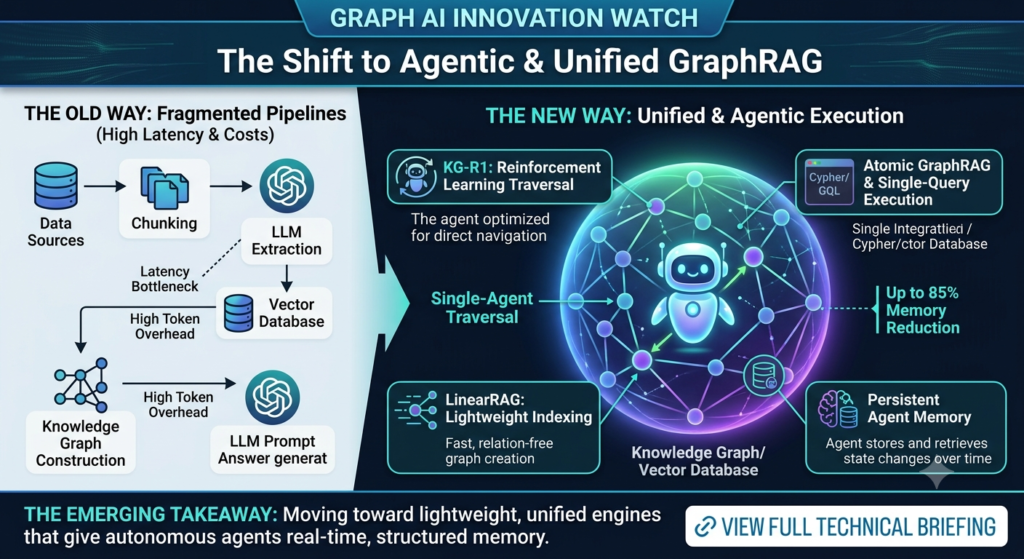
KG-R1: Unified Agentic Knowledge Graph Navigation via Reinforcement Learning
What happened: Researchers developed KG-R1, an agentic framework that replaces traditional multi-module GraphRAG pipelines (planning, extraction, reasoning) with a single model that directly interacts with knowledge graphs as its environment. Using Qwen 2.5-3B, the agent applies reinforcement learning to dynamically explore nodes and traverse edges during its reasoning process.
Why it matters: Eliminates the high token overhead and latency of multi-prompt LLM pipelines while demonstrating zero-shot transferability to unseen enterprise knowledge graphs without schema fine-tuning.
Tech Stack/Concepts: Qwen 2.5, Reinforcement Learning, Knowledge Graph Question Answering (KGQA), Single-Agent Traversal, Agentic RAG.
Source: arXiv:2509.26383 | Status: Open-Source Framework / Research Paper | Date: May 22, 2026
Memgraph 3.8 Releases Atomic GraphRAG and Single Store Vector Storage
What happened: Memgraph released version 3.8, introducing “Atomic GraphRAG” to execute complete multi-hop context retrieval inside a single ACID-compliant Cypher query. The engine update also adds a Single Store Vector Index that maintains a single vector array in memory while assigning lightweight references to native graph nodes.
Why it matters: Reduces vector memory overhead by up to 85% and eliminates external orchestration middleware latency when generating LLM context from connected enterprise data.
Tech Stack/Concepts: Cypher, Memgraph Engine, Single Store Vector Index, ACID Transactions, Parallel Query Runtime.
Source: Memgraph Engineering Blog | Status: GA Production Release | Date: February 12, 2026
LinearRAG Enables Relation-Free Graph Construction for Fast Retrieval
What happened: Researchers introduced LinearRAG, an index-free GraphRAG construction methodology that bypasses costly LLM-driven entity-relation extraction. Instead of constructing dense labeled property graphs, LinearRAG leverages topological entity co-occurrence and relation-free linking structures to build lightweight search graphs.
Why it matters: Cuts knowledge graph indexing time and LLM token costs significantly while preserving multi-hop retrieval accuracy over massive document corpora.
Tech Stack/Concepts: Topological Graph Indexing, LightRAG, Entity Co-occurrence, Relation-Free Linking.
Source: GitHub DEEP-PolyU / ICLR 2026 | Status: Peer-Reviewed Research Paper (ICLR 2026) | Date: January 26, 2026
SciAtlas Launches 3-Billion Triplet Graph for Autonomous Scientific Agents
What happened: Computer scientists deployed SciAtlas, a heterogeneous knowledge graph unifying 43 million papers across 26 scientific disciplines into a 3-billion triplet network. It integrates a neuro-symbolic retrieval algorithm using tri-path collaborative recall and graph reranking to guide agentic reasoning.
Why it matters: Provides an explicit topological cognitive substrate for AI research agents, replacing noisy vector similarity searches with deterministic association discovery across interdisciplinary domains.
Tech Stack/Concepts: Neuro-Symbolic Retrieval, Tri-path Recall, Heterogeneous Knowledge Graphs, Automated Hypothesis Generation.
Source: arXiv:2605.22878 | Status: Open-Source Dataset / Research Paper | Date: May 20, 2026
Serialized Graph Tokens Resolve Information Bottlenecks in Graph Transformers
What happened: Machine learning researchers engineered a serialized graph token paradigm that converts structural node aggregation into sequence tokens with embedded positional encodings. Stacked self-attention layers process these serialized token sequences to model deep internal graph interactions beyond simple node signal weighted sums.
Why it matters: Solves the global representation bottleneck in standard Graph Transformers, delivering state-of-the-art performance on node-level and graph-level ML benchmarks.
Tech Stack/Concepts: Graph Transformers, Serialized Graph Tokens, PyTorch Geometric, Self-Attention.
Source: arXiv:2602.09065 | Status: Peer-Reviewed Research Paper (ICASSP 2026) | Date: February 9, 2026
MemGraphRAG Anchors Dynamic Multi-Agent Memory onto Knowledge Graphs
What happened: AI engineers developed MemGraphRAG, an architecture that uses dynamic knowledge graphs to store, index, and retrieve long-term state changes and memory traces for autonomous agents. The system continuously updates graph nodes and relationships as agents execute multi-step workflows across operational sessions.
Why it matters: Solves long-horizon context drift and memory decay in agentic systems by grounding agent history in a structured, queryable knowledge repository.
Tech Stack/Concepts: Dynamic Knowledge Graphs, Agent Memory, Multi-Agent Orchestration, Temporal Knowledge Representation.
Source: GitHub DEEP-PolyU / KDD 2026 | Status: Peer-Reviewed Research Paper (KDD 2026) | Date: May 17, 2026
Emerging Graph Trends:
Recent developments demonstrate a clear movement away from fragmented multi-module GraphRAG pipelines toward unified single-agent environments and native in-database execution. Simultaneously, graph engine architectures are optimizing memory footprints by decoupling heavy vector storage from property nodes while preserving topological links. Finally, knowledge graphs are evolving into foundational memory substrates for autonomous agents, grounding multi-step reasoning and long-term state updates in structured networks.