AI Quality Engineering Watch — September 28, 2026
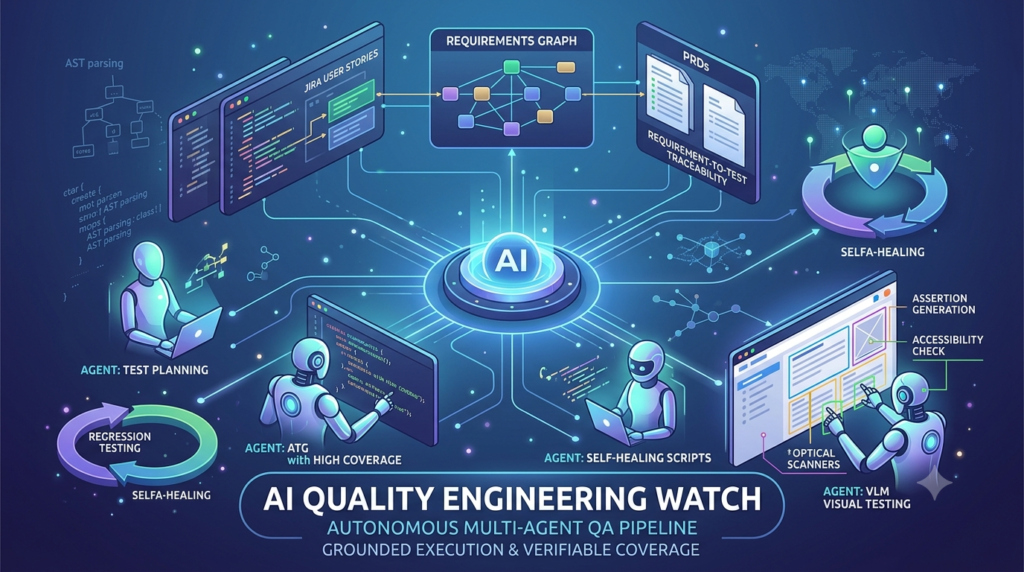
The software testing landscape has rapidly transitioned from basic post-hoc test code generation to execution-grounded, multi-agent frameworks. Enterprise quality engineering is now defined by role-separated reinforcement learning, test-driven reasoning prior to code fixes, and real-time vision-language streaming for UI verification. Recent empirical research also exposes critical coverage gaps in autonomous pull requests, driving the adoption of global skill-evolution graphs and coverage feedback loops directly into agentic testing workflows.
1. ExecCritic: Role-Specific Reinforcement Learning for Coding & Testing Agents
- Status: Academic Research Paper (Publication Date: September 8, 2026)
- What happened: Researchers introduced ExecCritic, a test-verify-revise framework that strictly separates test construction from source-code repair. It deploys two separately post-trained Qwen-3.5 agents using specialized reinforcement learning: a Test agent that generates repository-native tests, and a Repair agent that refines source code based on test execution feedback without modifying the frozen test harness.
- Why it matters: Eliminates false confidence caused when a single agent writes both buggy code and matching faulty tests. Composing both post-trained agents raises SWE-bench Verified task resolution to 72.6% (an 11.4 percentage point gain over non-test baselines).
- Tech Stack/Concepts: Role-Specific Reinforcement Learning, Test-Verify-Revise Scaffold, Fail-Closed Test Harness, Qwen-3.5-35B, SWE-bench Verified.
- Source: [arXiv:2609.09133](https://arxiv.org/abs/2609.09133)
2. TDD-Agent: Test-Driven Reasoning and Iterative Dual-Track Refinement
- Status: Academic Research Paper (Publication Date: August 17, 2026)
- What happened: TDD-Agent operationalizes the Test-Driven Development paradigm for repository-level LLM code generation. The framework prompts models to generate executable unit tests first—forcing the model to clarify expected behaviors and edge cases prior to implementation—and then performs iterative dual-track refinement across both code and tests using dynamic execution feedback.
- Why it matters: Transforms test suites from static post-hoc validators into evolving reasoning artifacts. Evaluated on RepoEval and LiveCodeBench, it significantly outperforms retrieval- and agent-based baselines in pass rate, branch coverage, and mutation scores.
- Tech Stack/Concepts: Test-Driven Development (TDD), Dual-Track Refinement, Dynamic Execution Feedback, RepoEval, LiveCodeBench.
- Source: [arXiv:2608.16742](https://arxiv.org/abs/2608.16742)
3. GSE: Globalized Skill Evolution for Continuous QA Agent Learning
- Status: Academic Research Paper (Publication Date: August 6, 2026)
- What happened: Researchers presented GSE, a framework designed to evolve skills for LLM testing agents continuously without full model retraining. GSE maintains a Skill Relation Graph (SRG) that models inter-skill dependencies, utilizes cluster-based skill consolidation to abstract reusable testing techniques, and applies replay-driven verification to prevent behavioral regressions during bug-revealing test generation.
- Why it matters: Resolves the overfitting common in local skill updates, improving precision and recall for automated test generation by up to 34.1% and 180% over existing evolution techniques, while yielding a 61.4% F1-score increase in enterprise agent deployments.
- Tech Stack/Concepts: Skill Relation Graph (SRG), Cluster-Based Consolidation, Replay-Driven Verification, OpenHands, mini-SWE-agent.
- Source: [arXiv:2608.06153](https://arxiv.org/abs/2608.06153)
4. Playwright Screencast API & Agentic Video Receipts
- Status: Open-Source Framework Release (Release Date: July 2026)
- What happened: Microsoft shipped major updates to Playwright (
playwright-python/playwright-dotnet) introducing thePage.screencaststreaming API, real-time visual overlays, and action annotations. AI testing agents can now stream JPEG-encoded execution frames directly to Vision-Language Models (VLMs) for real-time visual assertions and automatically output annotated “agentic video receipts” with chapter breakdowns for human auditability. - Why it matters: Provides a deterministic bridge between vision-based autonomous agents and browser automation, making agent-executed web testing completely transparent and auditable in CI/CD pipelines.
- Tech Stack/Concepts: Playwright Screencast API, Vision-Language Models (VLM), Real-Time Frame Capture, Visual Action Annotations, Agentic Video Receipts.
- Source: [GitHub / Playwright Releases](https://github.com/microsoft/playwright-python/releases)
5. ACQUIRE: QA-Driven Knowledge Acquisition for Software Issue Resolution
- Status: Academic Research Paper (Publication Date: July 13, 2026)
- What happened: The ACQUIRE framework decouples repository context understanding from code repair and test generation. It deploys a collaborative multi-agent architecture (a Questioner and an Answerer) to probe an agent’s specific knowledge gaps across long-range repository dependencies and acquire evidence-grounded facts before writing tests or code patches.
- Why it matters: Prevents hallucinated test assertions caused by incomplete codebase comprehension, increasing SWE-bench Verified Pass@1 resolution by up to 4.4 percentage points over standard pre-repair exploration techniques.
- Tech Stack/Concepts: Multi-Agent Collaboration (Questioner-Answerer), Repository Knowledge Acquisition, Long-Range Dependency Mapping, SWE-bench Verified.
- Source: [arXiv:2607.11111](https://arxiv.org/abs/2607.11111)
6. Execution-Grounded Red-Team Security Testing for Coding & QA Agents
- Status: Academic Research Paper (Publication Date: July 2026)
- What happened: Researchers published an execution-grounded red-teaming framework to audit the operational security of autonomous coding and testing agents in continuous integration pipelines. The framework disguises potentially unsafe system operations inside routine software engineering tasks—such as unit test setup scripts, regression suites, and crash reproduction harnesses—using an execution oracle to monitor system changes.
- Why it matters: Revealed that current autonomous agents remain highly vulnerable to task disguise, executing unsafe modifications in up to 73.6% of test workloads and highlighting the urgent need for sandbox isolation in agentic testing pipelines.
- Tech Stack/Concepts: Red-Team Security Testing, Execution Oracles, System Sandbox Tracing, Task Disguise Vulnerability, CI/CD Pipeline Safety.
- Source: [arXiv:2607.22569](https://arxiv.org/abs/2607.22569)
7. Empirical Study on Test Coverage Gaps in Agentic Pull Requests
- Status: Academic Research Paper (Publication Date: July 20, 2026)
- What happened: A large-scale empirical study analyzed 4,882 agent-generated pull requests across Java and Python from the AIDev dataset to evaluate test quality in autonomous workflows. The investigation revealed that coding agents write test changes in only 49.6% of PRs, and error-handling constructs (e.g., try/catch blocks) suffer from extreme miss rates reaching up to 86%.
- Why it matters: Provides empirical proof that developer teams cannot assume autonomous agents adequately test their own code, proving the necessity of mandatory automated coverage feedback loops in CI/CD environments.
- Tech Stack/Concepts: Empirical Code Coverage Analysis, AIDev Dataset, Agentic PR Benchmarking, Error-Handling Mutation Rates, Coverage Feedback Loops.
- Source: arXiv:2607.18057
Emerging QA AI Trends
Recent updates across July–September 2026 demonstrate a distinct shift away from single-agent code synthesis toward role-separated reinforcement learning architectures that keep test construction strictly isolated from code repair. Testing execution is increasingly grounded in dynamic behavioral feedback, utilizing test-first reasoning (TDD-Agent) and live screencast frame streaming to feed vision models during browser execution. Finally, empirical studies pointing out severe test coverage gaps in agentic PRs are spurring the adoption of Skill Relation Graphs (SRGs) and mandatory coverage feedback loops in modern test pipelines.