AI Technology Watch — September 14, 2026
Storyline Autonomous AI architectures are rapidly shifting from single-prompt reasoning to multi-agent parallel execution, domain-specific scientific intelligence, and standardized hardware interfaces. As long-horizon evaluation benchmarks highlight existing failure modes, researchers are prioritizing token-efficient inference and real-world system safety.
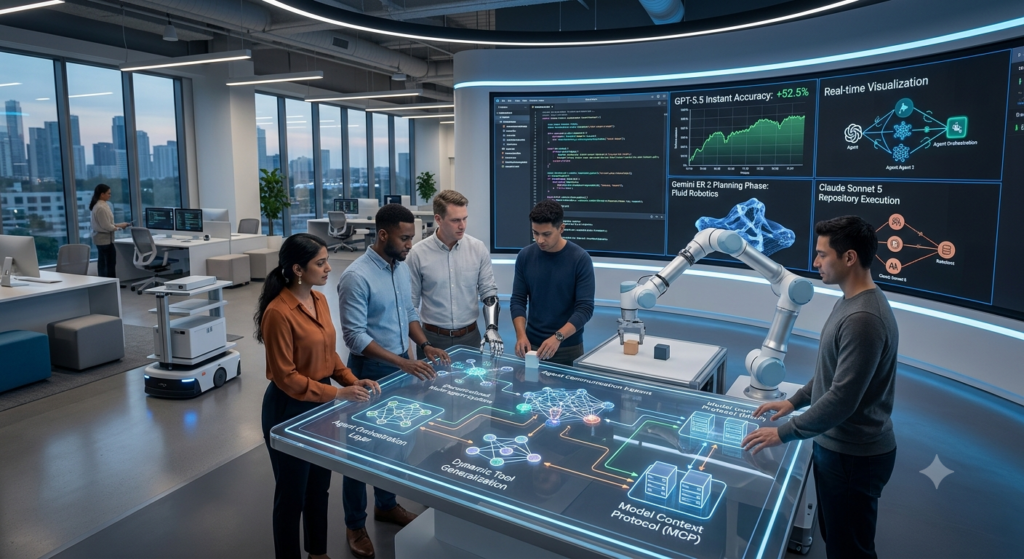
- OpenAI Launches GPT-5.6 Model Family with Parallel Agent Orchestration
- Publication Date: July 09, 2026 (Updated August 2026)
- What happened: OpenAI released its GPT-5.6 frontier model family (Sol, Terra, Luna) along with an “Ultra” mode that coordinates autonomous parallel agent workstreams. The flagship Sol model reached a 53.6 score on Agents’ Last Exam and an 80 on the Artificial Analysis Coding Agent Index, achieving state-of-the-art long-horizon performance using fewer output tokens and reduced execution latency.
- Why it matters: Parallel multi-agent orchestration significantly scales enterprise efficiency by allowing complex software engineering and research workflows to execute concurrently.
- Source: [OpenAI — GPT-5.6 Frontier Intelligence](https://openai.com/index/gpt-5-6/)
- Agents’ Last Exam (ALE) Benchmark Target Long-Horizon Enterprise Workflows
- Publication Date: June 03, 2026
- What happened: AI researchers released Agents’ Last Exam (ALE), a living evaluation benchmark covering over 1,000 tasks across 13 economic industry clusters to measure agent performance on extended professional tasks. Initial evaluation across mainstream models showed an average full pass rate under 1% on the hardest task tier.
- Why it matters: ALE establishes an outcome-verifiable benchmark that shifts evaluation away from short academic prompts toward economic utility and real-world workflow reliability.
- Source: [arXiv — Agents’ Last Exam](https://arxiv.org/abs/2606.05405)
- Anthropic Previews Model Hardware Standard for Embodied Agent Safety
- Publication Date: August 27, 2026
- What happened: Anthropic launched a research preview of the Model Hardware Standard (MHS), an open shared specification enabling AI agents to interact with physical instruments and industrial hardware safely. MHS implements hardware-level execution constraints and safety handshakes for scientific labs and manufacturing environments.
- Why it matters: Standardizing hardware-agent safety layers is essential to move autonomous AI out of purely digital sandboxes into physical robotics and laboratory automation.
- Source: [Anthropic — Model Hardware Standard](https://www.anthropic.com/news)
- Claude Fable 5.1 & Mythos 5.1 Introduced for Science and Code Synthesis
- Publication Date: September 01, 2026
- What happened: Anthropic released Claude Fable 5.1 and Mythos 5.1, specialized models featuring domain-specific adaptive reasoning pipelines for complex software engineering and biology research. The releases introduce enhanced safety safeguards to prevent autonomous misuse during multi-step technical problem solving.
- Why it matters: Domain-tailored model reasoning architectures provide higher precision and alignment for enterprise scientific discovery than generalized base models.
- Source: [Anthropic — Claude Fable 5.1 and Mythos 5.1](https://www.anthropic.com/news)
- Cellular RAG Framework and Hybrid Architecture for Scientific Agents
- Publication Date: May 25, 2026
- What happened: A research paper introduced a hybrid Local Body / Remote Brain agentic architecture featuring “Cellular RAG” for fine-grained knowledge retrieval. Demonstrations across DeepTS and DeepScribe showed autonomous multi-agent pipelines curating time-series datasets and transforming complex lecture visuals into structured technical reports.
- Why it matters: Granular cellular retrieval solves context degradation in multi-modal scientific workflows while keeping execution low-cost and concurrent.
- Source: arXiv — Experiments in Agentic AI for Science
Emerging Trends
- Parallel Multi-Agent Workstreams: Frontier model developers are pivoting from single sequential reasoning chains to parallelized agent clusters, drastically reducing execution latency and token costs on long-horizon tasks.
- Physical and Hardware Safety Abstrations: As autonomous AI expands into robotics and lab equipment, standardized hardware specs and security protocols are emerging to contain physical physical risks.
- Shift to Verifiable Economic Benchmarking: Evaluation is transitioning from academic question answering toward continuous enterprise workflows (such as Agents’ Last Exam) that verify real-world business productivity.