Every time a new frontier model drops, a familiar frenzy ripples through the QA engineering community. The immediate reaction is a scramble to upgrade our pipelines to the latest release, operating on the assumption that a newer model automatically translates to better testing outcomes.
Is the upgrade actually justified?
The reality is that most QA teams lack clear, domain-specific benchmarks for evaluating LLMs. We end up over-engineering simple workflows and draining operational budgets by deploying high-tier flagship models for routine tasks that lighter, lower-cost options can handle with identical precision.
To build sustainable, AI-driven quality engineering frameworks, we must stop evaluating models based on social media hype and start grounding our decisions in task complexity, cost governance, and targeted benchmarks.
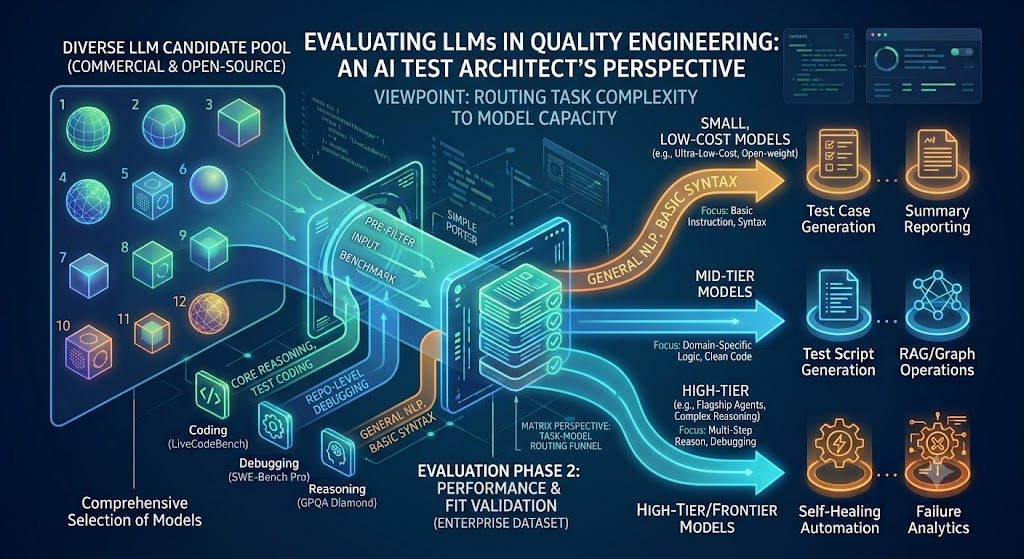
The Cost Reality: Matching Cognitive Footprint to Complexit
Cost is the single biggest bottleneck when scaling AI across continuous integration pipelines. Imagine using an expensive, ultra-tier flagship model simply to parse a user story and outline basic functional test cases. That is the equivalent of spinning up a supercomputer cluster to run a standard calculator application.
In Quality Engineering, a model’s required accuracy is bounded by the task itself. Generating boundary value test cases from acceptance criteria does not require complex spatial reasoning—it requires structured instruction following and clean JSON outputs. By matching the model’s cognitive capacity to the specific workload, you can achieve identical pass rates while reducing token costs by up to 80%.
Deconstructing the Workload Across the STLC
To select the right model, we must break down the Software Testing Life Cycle (STLC) into its core components and evaluate what each phase demands:
- Requirement Analysis & Test Planning (Graph & RAG Operations)
- The Task: Traversing knowledge graphs or vector databases to contextualize system dependencies, business rules, and multi-service workflows.
- Requirement: High contextual comprehension and multi-step relational reasoning.
- Test Design (Test Case Generation)
- The Task: Extracting test scenarios, positive/negative paths, and edge cases from user stories and acceptance criteria.
- Requirement: Strong instruction following, consistency, and structural adherence.
- Test Implementation & Execution (Test Script Generation)
- The Task: Translating manual test steps into executable automation scripts (using frameworks like Playwright, Selenium, or PyTest).
- Requirement: Precise code syntax, current library awareness, and minimal code hallucination.
- Defect Management & Maintenance (Self-Healing)
- The Task: Detecting runtime locator failures during test execution and dynamically generating patches for broken selectors without human intervention.
- Requirement: Codebase spatial awareness and real-time debugging capabilities.
- Defect Analysis (Failure Analytics)
- The Task: Analyzing complex stack traces, application logs, and network traffic to isolate root causes across microservices.
- Requirement: Deep logical reasoning, pattern recognition, and multi-file code tracing.
- Test Reporting & Closure (Summary & Reporting)
- The Task: Aggregating test run logs into human-readable executive summaries and trend dashboards.
- Requirement: Basic Natural Language Processing (NLP) and document summarization.
Public Benchmarks: My Personal Evaluation Criteria
General conversational benchmarks do not indicate whether an LLM can parse a complex microservice architecture or fix a flaky selector. Based on my personal analysis as a Test Architect, I track three public benchmarks to evaluate model readiness for testing frameworks. However, these reflect my specific architectural strategy—I encourage every team to analyze and define their own benchmark criteria based on their tech stack.
- SWE-Bench Pro (Coding & Debugging): Evaluates an AI’s ability to solve real-world software engineering issues across complex codebases. In QA, this is the primary indicator for Self-Healing and Failure Analytics, measuring whether a model can navigate repository dependencies to fix broken scripts or trace bug origins. (labs.scale.com/leaderboard/swe_bench_pro_public)
- LiveCodeBench (Coding Capability): Continuously evaluates coding performance across generation, repair, and execution without data contamination. This is my benchmark for Test Script Generation, showing how reliably a model produces runnable automation code without hallucinating deprecated methods. (livecodebench.github.io)
- GPQA Diamond (Deep Reasoning): Tests domain-level multi-step reasoning capabilities. High performance here maps directly to Graph and RAG Operations, where the model must synthesize indirect relationships across system architecture graphs. (artificialanalysis.ai/evaluations/gpqa-diamond)
The Gold Standard: Building an Enterprise Benchmark Dataset
While public benchmarks offer a reliable baseline, they cannot replace internal validation. Public leaderboards evaluate general capabilities; they do not know your application’s domain logic, custom automation frameworks, or proprietary logging structures.
Every enterprise QA organization should establish an internal Golden Dataset Benchmark:
- Curate Real Artifacts: Assemble a dataset of 50 to 100 historical project artifacts—including actual Jira user stories, legacy Playwright/Selenium suites, past microservice stack traces, and domain knowledge graph queries.
- Define Precision Metrics: Establish pass/fail criteria based on functional execution accuracy, syntax validity, hallucination rate, and token cost.
- Run Comparative Evaluations: Whenever a new model tier or version is released, run your Golden Dataset through an automated evaluation harness.
Evaluating new releases against your internal Golden Dataset provides definitive proof of whether an upgrade yields measurable quality improvements for your specific software, or if it simply increases infrastructure cost.
The Task-to-Model Selection Matrix
To build an effective routing strategy, you must combine your evaluation layers into a two-tiered funnel. Public benchmarks act as your market pre-filter (determining if a model is conceptually capable), while your Enterprise Golden Dataset acts as your internal gate (proving it works on your actual codebase).
| STLC Phase | QA Workload Area | Public Benchmark (Market Pre-Filter) | Enterprise Golden Dataset Target (Internal Gate) | Recommended Model Tier |
| Test Closure | Summary & Reporting | Basic NLP / Instruction Following | 100% accuracy on internal run log & artifact summaries | Compact / Ultra-Low-Cost Models |
| Test Design | Test Case Generation | Basic Code & Syntax Metrics | Zero omission on internal Jira user story acceptance criteria | Small / Mid-Tier Models |
| Requirement Analysis | Graph & RAG Queries | GPQA Diamond (Reasoning) | Accurate mapping of internal microservice dependency graph | Mid-Tier Reasoning Models |
| Test Implementation | Test Script Generation | LiveCodeBench (Coding) | Valid execution against proprietary framework (Playwright/Selenium) | Mid-Tier Code Models |
| Defect Management | Self-Healing Automation | SWE-Bench Pro (Debugging) | >90% fix rate on historical flaky locator suite | High-Tier / Specialized Agents |
| Defect Analysis | Failure Analytics | SWE-Bench Pro & GPQA Diamond | Root cause identification on historical multi-service trace logs | High-Tier / Frontier Models |
Architectural Strategy
Stop letting release announcements dictate your testing architecture. Implement dynamic routing within your QA framework: direct lightweight tasks like test case creation and reporting to compact, cost-effective models, and reserve high-reasoning flagship calls for complex failure analytics and real-time self-healing. Base your model upgrades on your enterprise Golden Dataset rather than market noise, ensuring your testing infrastructure remains performant, accurate, and cost-efficient.