In our last post, we introduced what-is-agentic-ai-orchestration and its foundational concepts. Today, we are diving deeper into those core principles, focusing specifically on Task Decomposition—the process that turns complex human prompts into structured, actionable plans.
Imagine that you have just entered your vacation request into the travel assistant.
“I want to visit India, suggest me some good places to visit and places to stay, also provide me some train/air options from London on 28th-Dec-2026.”
To a human, this request is straightforward. We understand the destination, the departure location, the date, and the desired recommendations.
An AI system, however, must transform this conversational request into information that its components can process reliably.
The orchestrator needs to identify the user’s intentions, extract the relevant parameters, and determine which agents are required.
This process can be understood through four steps.
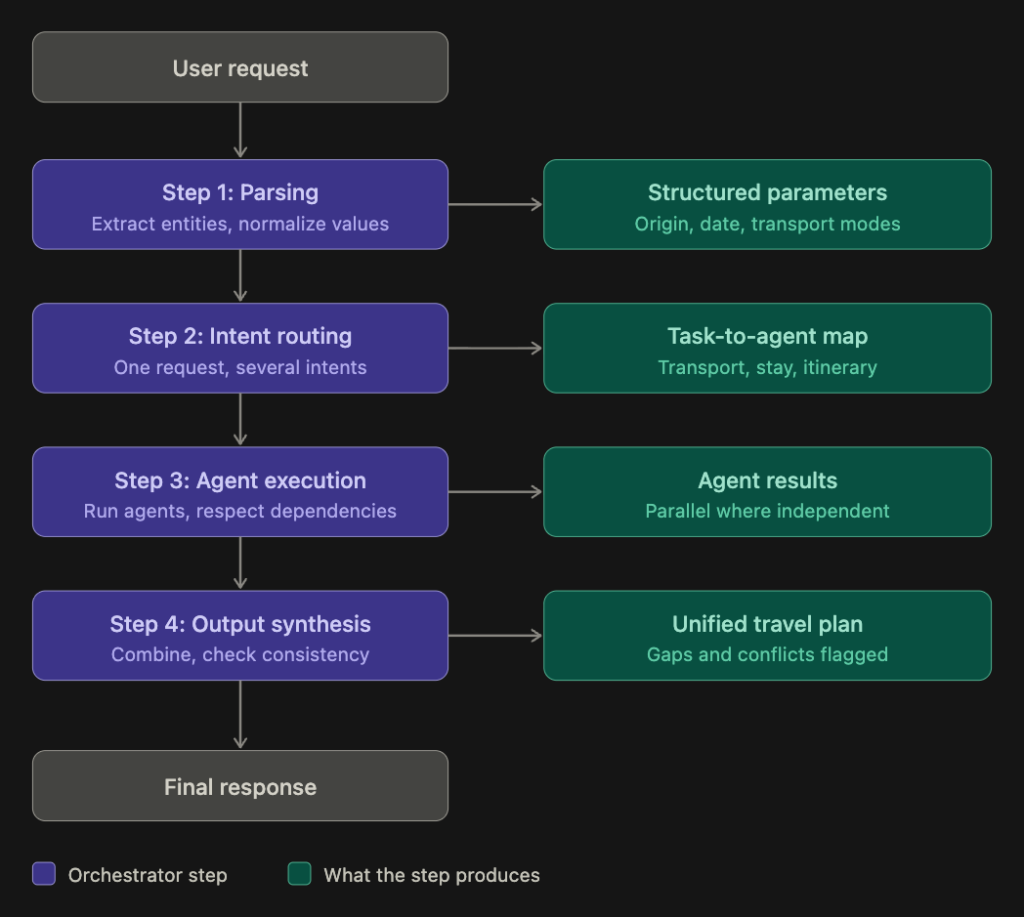
Step 1: Parsing and Entity Extraction
The orchestrator first processes the user’s message using an LLM, a natural language understanding component, or a combination of language-processing techniques.
It identifies important pieces of information, including locations, dates, and requested activities.
For our travel request, the extracted information might look like this:
| Parameter | Extracted Value | Purpose |
|---|---|---|
| Origin | London | Identifies the departure location |
| Destination | India | Identifies the destination country |
| Travel date | December 28, 2026 | Establishes the requested departure date |
| Transport modes | Air and rail | Defines the transportation options to search |
| Required recommendations | Places to visit and stay | Identifies accommodation and itinerary tasks |
The orchestrator may also normalize these values into machine-readable representations.
For example, the date can be represented as 2026-12-28.
London can be resolved to an appropriate airport or rail-station context, depending on the transport mode. If flights are being considered, the system might use a London airport grouping or a specific airport code such as LHR or LGW.
Similarly, India can be represented as a country-level destination, while a later planning step identifies specific cities.
The important point is that extraction and normalization turn an open-ended conversation into structured information.
The system must also distinguish between what the user explicitly requested and what still needs clarification. For example, the user has not specified a return date, budget, or preferred Indian city.
A reliable orchestrator should not silently invent these details.
Step 2: Intent Routing
Once the relevant parameters have been identified, the orchestrator determines what the user wants the system to accomplish.
In our example, a single sentence contains several intents:
| User’s Request | Identified Intent | Responsible Agent |
|---|---|---|
| “Provide me some train/air options” | Find transportation | Flight or Rail Agent |
| “Suggest some good places to visit” | Recommend destinations | Destination or Itinerary Agent |
| “Places to stay” | Find accommodation | Accommodation Agent |
The exact agent names depend on the application’s architecture.
Notice something interesting: one user request can activate multiple capabilities.
A conventional chatbot might answer the entire question in a single response. An agentic system can instead coordinate multiple specialized components, potentially using external tools and APIs to retrieve current information.
Step 3: Agent Execution
After identifying the required tasks, the orchestrator decides which agents should execute them.
For example, it might initiate the following workflow:
- The Flight or Rail Agent searches for transportation options.
- The Destination Agent identifies suitable places to visit.
- The Accommodation Agent searches for relevant hotels.
- The Itinerary Agent combines the results into a practical plan.
The tasks do not always need to run sequentially.
Destination recommendations and preliminary accommodation searches might run in parallel. However, selecting an airport hotel may depend on knowing the actual arrival airport and arrival time.
This introduces an important orchestration decision: which tasks can execute independently, and which tasks depend on the output of another agent?
The orchestrator uses these dependencies to construct an appropriate execution plan.
Step 4: Output Synthesis
Once the agents return their results, the orchestrator combines them into a coherent response.
Instead of displaying disconnected outputs from different agents, it might present transportation options, recommended destinations, accommodation choices, and suggested next steps in a unified travel plan.
The orchestrator may also identify missing information or conflicting results before presenting the final response.
For example, if the Flight Agent finds an arrival in Delhi but the Accommodation Agent has searched for hotels in Mumbai, the system should detect and resolve the inconsistency.
That brings us to the next challenge.
Even when every agent performs its task correctly, how do we ensure that the agents share the right information?
One Response