Imagine planning an international vacation using nothing more than a single conversation.
You tell an AI assistant that “you want to visit India. You ask it to recommend places to explore, suggest hotels,and find suitable train or flight options from London for December 28, 2026.“
What happens next behind the scenes?
- Does a single AI model perform every task?
- Does it call multiple APIs sequentially?
- Does it delegate distinct responsibilities to specialized AI agents?
- How does it ensure every agent receives accurate context so the entire journey comes together seamlessly?
This is where Agentic AI Orchestration enters the picture.
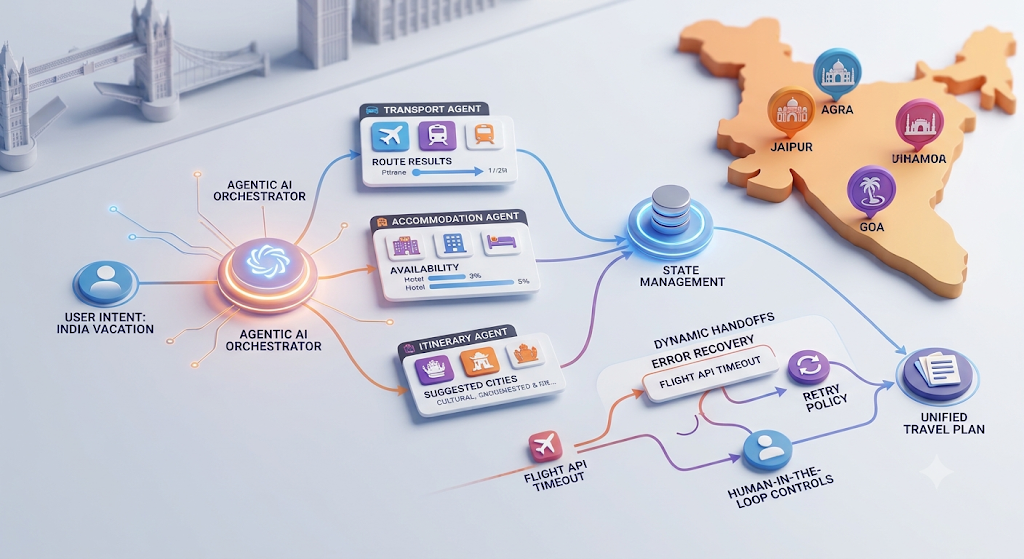
As AI systems evolve from simple text-in/text-out chatbots into autonomous, goal-oriented agents,orchestration is becoming one of the most critical architecture patterns to master. It is the mechanism that coordinates agents, manages persistent state, routes dynamic execution paths, and handles runtime failures gracefully.
Frameworks such as LangGraph, LangChain, Google’s Agent Development Kit (ADK), and Microsoft’s AutoGen provide distinct approaches to building these systems. But before exploring how these frameworks work, let’s unpack orchestration through a practical real-world scenario.
Understanding Agentic AI Orchestration
Let’s return to our vacation-planning scenario. You open a travel platform powered by AI and enter the following prompt:
“I want to visit India. Suggest some good places to visit and stay, and provide train or flight options from London for December 28, 2026.”
Your single request triggers several independent sub-tasks:
- Transport Lookup: Finding suitable flights or rail routes.
- Destination Research: Recommending regional destinations in India.
- Lodging Search: Searching for contextually relevant hotels.
- Itinerary Timing: Factoring in specific arrival times into the daily plan.
- Synthesis: Coordinating separate outputs into a actionable, unified travel plan.
Instead of overloading a single LLM prompt to execute everything at once, a robust system delegates these activities to specialized autonomous agents.
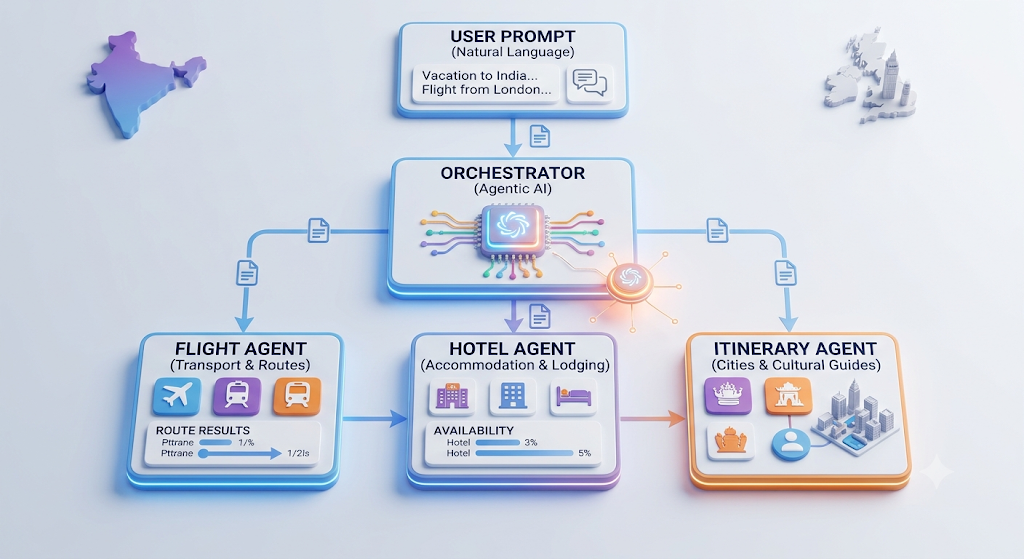
For instance, a Flight Agent searches transport schedules, an Accommodation Agent queries lodging APIs,and an Itinerary Agent generates curated activities.
The Role of the Orchestrator
With multiple agents working concurrently, critical architectural questions arise:
- Who decides which agent runs first?
- Who guarantees the Accommodation Agent knows where the traveler lands?
- Who handles workflow recovery if the flight API times out or fails?
The orchestrator coordinates the entire lifecycle.
Think of it as the head planner organizing a complex trip. It understands the end goal, assigns responsibilities to domain specialists, tracks intermediate progress, and synthesizes final results. In production environments,an orchestrator can be implemented using an LLM-driven controller, a deterministic finite state machine (FSM), a graph workflow, or a hybrid approach.
The Four Core Responsibilities of an Orchestrator
A production-grade orchestration engine relies on four fundamental architecture pillars:
| Pillar | Core Function | Example Action |
| 1. Task Decomposition | Breaks monolithic user intents into discrete, manageable sub-tasks. | Splits vacation request into transport, lodging, and itinerary tasks. |
| 2. State & Context Management | Maintains a centralized execution state across agent handoffs. | Passes departure date and destination from transport agent to hotel agent. |
| 3. Dynamic Routing & Handoffs | Controls execution paths dynamically based on runtime outputs. | Routes late-night arrival outputs directly to airport hotel search agents. |
| 4. Error Recovery & Guardrails | Handles API exceptions, validates schemas, and applies retries. | Triggers fallback airport search or prompts user when flights are unavailable. |
1. Task Decomposition
The orchestrator analyzes open-ended natural language inputs and breaks them into structured task graphs that can be assigned to targeted agents or tool pipelines.
2. State and Context Management
Large language models are inherently stateless across isolated calls. The orchestrator maintains shared execution state and memory so subsequent agents don’t re-ask questions or make blind assumptions.
3. Dynamic Execution and Handoffs
Real-world workflows rarely follow a linear path. The orchestrator dynamically routes execution flow, evaluates conditional steps, and executes independent tasks in parallel when dependencies allow.
4. Error Recovery and Guardrails
When external tool calls fail or data schemas break, the orchestrator enforces validation boundaries, manages retry backoff limits, or escalates the task for human approval via Human-in-the-Loop (HITL) patterns.
Understanding these four responsibilities forms the foundation of modern agentic system architecture.
What’s Next in This Series ?
Understanding these four responsibilities forms the foundation of modern agentic system architecture. Over the remaining six parts of this series, we will dissect each phase in detail with concrete examples and code patterns.
One Response