Graph Tech & AI Watch — September 16, 2026
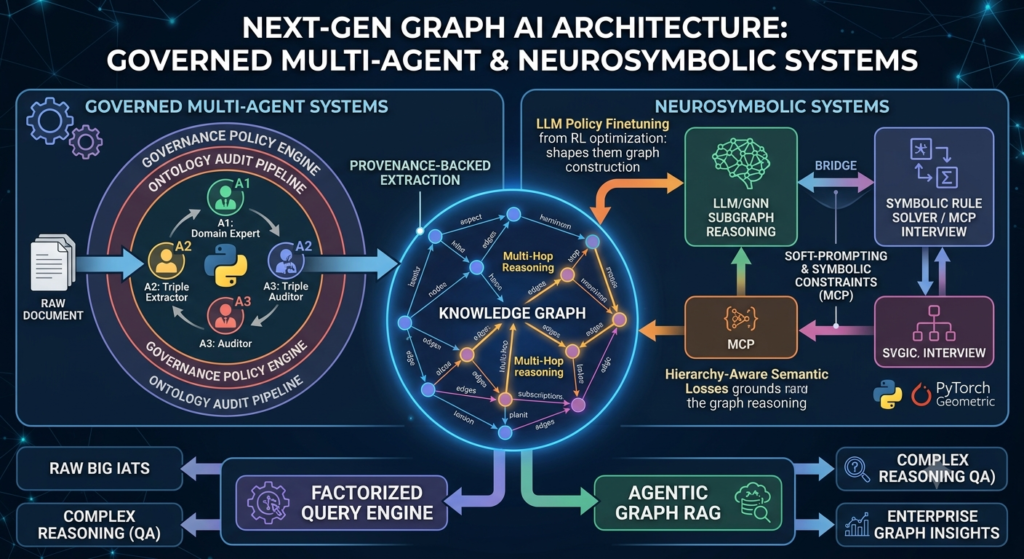
Knowledge representation engineering is pivoting from static graph construction toward agentic governance and adaptive dynamics. Breakthroughs over the past eight weeks introduce multi-agent ownership frameworks, neurosymbolic graph discovery via model context protocols, hierarchy-aware semantic losses for GNN embeddings, and formal graph-grounded ontology induction that replaces unconstrained generative indexing.
1. Multi-Agent Knowledge Graph Construction with Domain-Expert Governance (MAGG)
Status: Research Paper
Date: August 12, 2026
Researchers introduced MAGG, a multi-agent framework designed to transform knowledge graphs from flat collections of triples into governed enterprise assets. The framework uses a domain classifier to identify entity and relationship types directly from raw documents. Candidate triples are then assigned to specialized domain-expert agents, which audit and approve the information before it is added to the knowledge graph.
For question answering, MAGG routes queries to the relevant domain experts instead of relying on global, undifferentiated retrieval. This approach introduces greater provenance, ownership, and governance into automated knowledge graph construction.
The results are also significant: on the MuSiQue multi-hop benchmark, MAGG reportedly outperformed Microsoft GraphRAG by 9.0 exact-match points and 11.2 token-F1 points.
Key concepts: Multi-Agent Systems, Domain Governance, GraphRAG, Open-World Ontology Induction
Source: arXiv:2608.28642
2. Noēsis: Decoupled Bidirectional Graph-RAG with Adaptive Parallelism
Status: Open-Source Framework / Research Paper
Date: August 16, 2026
The Noēsis architecture takes a different approach to GraphRAG by separating LLM-based information extraction from graph storage through an asynchronous graph-worker pipeline. Its Graph-Feedback Context Resolver performs bidirectional graph traversals, allowing the system to simulate sequential reading while managing the degradation of contextual memory.
Another component, called the Mesh Router, identifies semantic connections between different knowledge bases at query time using graph-derived centroid fingerprints. This allows related information to be discovered without requiring all knowledge bases to be merged into one global graph.
The approach aims to remove single-pass extraction bottlenecks and enable extremely fast cross-graph query routing without expensive global graph unification or complete re-indexing.
Key concepts: Python, Redis, Qdrant, AIMD Parallel Controllers, Bidirectional Graph Traversal
Source: arXiv:2608.15919
3. Graph-Grounded Domain Ontology Induction with Constrained LLM Workflows
Status: Research Paper
Date: August 22, 2026
This research presents a seven-stage pipeline for converting domain-specific documents into auditable OWL Terminological Boxes (TBoxes). Instead of allowing an LLM to freely generate an ontology, the system uses constrained workflows to control how concepts and relationships are extracted.
The documents are first represented as Unified Discourse-Hypergraphs (UDH) that capture relationships and dependencies within the discourse. These structures are then transformed into class hierarchies, object and datatype properties, and restriction axioms.
A major benefit of this approach is its emphasis on deterministic ontology construction and provenance. The resulting ontologies can also be validated using SPARQL, providing a more systematic way to verify the generated knowledge structures.
Key concepts: OWL, SPARQL, Unified Discourse-Hypergraphs (UDH), Constrained Prompting
Source: arXiv:2608.22135
4. Hierarchy-Aware Semantic Losses for Knowledge Graph Link Prediction
Status: Research Paper
Date: August 24, 2026
This work introduces hierarchy-aware semantic loss functions based on box embeddings for Graph Neural Network (GNN) models used in knowledge graph link prediction. Rather than representing subclass relationships as additional graph edges, the method incorporates hierarchical constraints directly into the model’s vector-space learning process.
The approach is designed to help GNNs understand ontological relationships without unnecessarily increasing the structural complexity of the graph. According to the reported results, the method achieved MRR improvements of up to 15.5% on BioKG compared with conventional approaches based on edge augmentation.
The research suggests that semantic constraints can provide a more efficient way of representing ontology information than simply adding more topological edges to the graph.
Key concepts: PyTorch Geometric, Box Embeddings, GNN Encoders, Semantic Loss Functions
Source: arXiv:2608.22981
5. MAAGL: Multi-Agent Graph Learning via Structural Signatures
Status: Research Paper
Date: September 10, 2026
MAAGL addresses two major challenges in agentic graph learning: the sensitivity of LLMs to graph serialization order and the rapid growth of context when large graph neighborhoods are converted into text.
The framework divides graphs into local communities and assigns specialized agents to work on different portions of the graph. It also separates structural evidence from semantic evidence. Instead of repeatedly verbalizing large graph neighborhoods, MAAGL represents topology using fixed-size, permutation-invariant structural signatures and filters node-level semantic information based on relevance.
This design aims to reduce context explosion while preventing reasoning biases caused by the order in which graph structures are presented to an LLM.
Key concepts: Multi-Agent Collaboration, Structural Signatures, Community Detection, Permutation-Invariant Encodings
Source: arXiv:2609.09565
6. Neurosymbolic Discovery of Algebraic Graph Constructions via MCP
Status: Research Paper
Date: August 8, 2026
Researchers have also demonstrated a practical combination of LLM-based agents with symbolic graph mathematics. The proposed system takes raw graph adjacency data and attempts to discover concise algebraic descriptions of the underlying graph structures, including constructions such as Cayley graphs.
The LLM agent communicates with the SageMath computer algebra system through a Model Context Protocol (MCP) server. The agent can propose structural hypotheses, while SageMath performs exact symbolic and graph-isomorphism checks to verify those hypotheses.
This creates a bridge between the flexible hypothesis-generation capabilities of LLMs and the exactness of symbolic mathematical algorithms. The approach demonstrates how neurosymbolic systems can potentially automate the structural classification of complex networks without requiring a task-specific neural model.
Key concepts: Model Context Protocol (MCP), SageMath, Neurosymbolic AI, Structural Isomorphism
Source: arXiv:2608.08118
Emerging Trends
Taken together, these developments point toward several important directions in Graph AI.
First, knowledge graphs are becoming more agentic and governed. Multi-agent architectures such as MAGG and MAAGL introduce specialized agents that can manage different domains or graph communities rather than relying on a single general-purpose retrieval process.
Second, GraphRAG is becoming more efficient and scalable. Architectures such as Noēsis focus on asynchronous processing, adaptive parallelism, and cross-graph retrieval, while MAAGL addresses the growing context requirements of graph-based reasoning.
Third, LLMs are increasingly being constrained by formal knowledge representations. The ontology-induction research demonstrates how OWL, SPARQL, and structured intermediate representations can be combined with LLMs to improve auditability and reduce unconstrained generation.
Finally, Graph AI is moving toward deeper integration between neural and symbolic methods. The MCP-based SageMath system illustrates how LLM agents can generate hypotheses while symbolic systems provide exact verification. This combination could become increasingly important for applications where AI-generated graph reasoning needs to be both flexible and mathematically verifiable.